Deliberate Incompetence as a Cover for Self-Destructive Policy

Hi Everyone,

The level of incompetence within Government appears to be staggeringly high. Almost everything they do fails or backfires. Their actions typically make the problems worse or create even more problems. This is happening in almost every Western country. I have experienced it firsthand in Australia and now in the UK. Ever since the start of the Covid-19 fiasco, these levels of incompetence have rapidly worsened.
The Apparition of Incompetence
From the UK alone, there are dozens of examples of apparent incompetence.
- Wasteful expenditure on projects that take years to commence and, in some cases, never do (e.g., the UK HS2 rail project (Building Construction Design)).
- Policies that exacerbate problems they are intended to solve (e.g., people entering the UK illegally (Global Statistics)).
- Grotesque errors of implementation (e.g., accidentally releasing dangerous criminals from prison (BBC)).
- Not building new or maintaining existing infrastructure such as schools, prisons, hospitals, roads, reservoirs, etc. (The Productivity Institute).
- Politicians making ridiculous gaffes (e.g., Keir Starmer’s famous ‘release the sausages’ remarks (The Guardian)).
- Political party infighting and indecisiveness over policies leading to an excess number of policy U-turns (e.g., over a dozen U-turns in the Labour Government’s first two years (Sky News).
- Regular but relatively small incidents of potential corruption (e.g., not declaring expensive gifts, not paying correct tax, falsifying CVs, and hiring people with connections to paedophiles (The iPaper)).
- Government leadership verbally attacking working-class people by calling them ‘far right’ when they express anger over immigration policy (Express).
- The Prime Minister spends an excessive amount of time overseas and on foreign policy, thus neglecting the many domestic problems such as the failing health service, housing crisis, and cost of living crisis (The Guardian).
Most of these are just some of the examples from the past two years alone under the current Labour Government.
All of the above looks like gross incompetence; the majority of the people in the UK believe this to be the case. In September 2025, YouGov conducted a survey asking people how they feel about the Government’s performance regarding competence and trust.
UK Government Approval Ratings

Source: YouGov
The UK Government’s approval ratings have plummeted to almost record lows within just over a year of the Labour Government taking office. They are almost as disliked as the previous Conservative Government, which appeared almost equally incompetent.
Questions Relating to Competence


Source: YouGov
Based on the survey, the people find the Government to be weak, out of touch, untrustworthy, lacking direction, incompetent, self-serving, uncaring, and a little intolerant. However, most did not find them extreme; this is an important observation in regard to what the Government wants people to believe regarding its intent.
Opinions Relating to Trust

Source: YouGov
The level of trust of the Government is incredibly low in every area asked. The highest area of trust is ‘protecting minorities’, which only 33% of the population trust them to do. Less than 15% expect the Government to keep their promises. Considering the Government’s lack of success in solving any existing problems, it is not surprising people have lost trust in them.
Capturing Votes to Win Elections
The apparent lack of competence is a key reason people have lost trust in the Government, but that alone does not fully satisfy much of the public. People also believe that political parties put their own priorities above national interests (The Conversation). This sentiment applies to both Establishment parties, Labour and Conservative, and the same claims are being made about the new Reform Party.
The claims that the UK has become a two-tier system are, in part, based around the idea that parties are targeting particular groups. ‘Right-wing’ politicians claim ‘Left-wing’ parties favour minority ethnic groups to capture their votes. They sell the favouritism to their base as promoting equality. ‘Equality’ has been an area ‘left-wing’ parties have promoted for a long time and has become an established policy goal (Horn, Jensen, and Weisstanner). ‘Left-wing’ politicians claim ‘right-wing’ parties point this out to sow division and win the vote of the native ethnic majority, whom they often claim to have far-right leanings (BBC). It is a divide-and-conquer strategy that also serves the purpose of demonstrating that parties are self-interested in maintaining or obtaining power.
Deep State Conspiracy
Another argument has been made that the deep state prevents the application of Government policies. This claim has been made by ‘right-wing’ politicians such as former UK Prime Ministers Liz Truss (Huffington Post) and Boris Johnson (Bell, E.).
These politicians’ version of the deep state is not the same as what I refer to as the Establishment, which I discuss in many of my posts. They are referring to the civil service area of the public sector. Their role is to implement executive branch policies. The claim is that the heads of civil service delay or even block the implementation of ‘right-wing’ policies or even policies not considered ‘woke’.
The civil service is likely to attract people with ‘left-leaning’ views of the world. This is because ‘left-wing’ ideology is orientated towards larger Government and more Government control, thus making it an attractive destination for anyone who wants to contribute to building it. People with ‘right-leaning’ views of the world are more likely to be attracted to the private sector. In doing so, they would be supporting their own positive views of capitalism.
People working in the public sector are more likely to join a union than people working in the private sector. In the UK, almost half of all public sector workers are part of a union. Whereas less than 12% of private sector workers are part of unions (worker-participation.eu). Higher union participation is likely to push public/civil servants closer to the ‘left’.
The extent to which ‘left-leaning’ people dominate civil service and top-level civil service jobs is difficult to fully determine.
It is quite possible that many top-level civil servants would personally be less receptive to policies that they consider ‘right-wing’ or made by a Government that is labelled ‘right-wing’. In theory, they could offer resistance to such policies. However, such resistance could not be sustained because they are still employees and can be replaced for reasons such as misconduct.
Despite ideological differences, most people would not want to risk losing highly paid jobs nor risk the damage to their reputation. Top-level civil servants might become bold enough to oppose a ‘right-wing’ Government if they strongly believe that the Government is on the way out, but they would also know that they could not be entirely sure how events will play out.
Masking the Agenda
The UK is widely regarded as one of the most established democracies in the world. Its democratic institutions are some of the earliest to be established in the world. Why would the political elite want such a tradition marred with incompetence? They would not!
The apparent incompetence is orchestrated. The UK Government, like most other Western Governments, is deliberately destroying their countries. They are destroying their economies, society, and culture. This extends beyond just current Governments. It extends to all Establishment parties and even most emerging parties.
If the people believe their Government as well as all other political alternatives are actively trying to destroy their country, many would lose hope in the democratic process that will not and cannot lead to change. Therefore, they will feel pressured to cause change through other means, which could lead to people rising up against the Government, the political class, and the system. It is a little too early for that to happen now.
The Establishment, through the Government, needs to destroy the country in a manner to avoid strong resistance. Creating the impression of incompetence is a good approach to this. Incompetent leadership could be dealt with through the political system. Incompetent leaders can be replaced with competent leaders. Such possibility gives people some hope that through the democratic processes of their system, positive change can be achieved if good leaders are elected to power.
People are also more willing to believe the current failures in Government policy are related to incompetence than deliberate malice. This is because deliberately harming the country is not in the party’s best interests. If a political party wants to win an election, it needs to please people for them to vote for them. We could call it a form of enlightened self-interest. This is based on the assumption that a party’s main goal is to win an election.
The majority of people believe that politicians/parties are placing self-interests above doing the ‘right thing’. On an individual basis, this would explain why there is so much corruption in politics, which is not in the interests of the people of a country.
On a party basis, the goals of the party winning an election and remaining in Government, should align with at least some of the people’s objectives; otherwise, the party would not win. Even if a Government is entirely self-serving, democracy can function if there is an opposition party that could replace them, thus holding them to account to a certain extent.
Many countries with Western-style democracies are some of the most successful countries in the world. I would argue that this has more to do with capitalism and the Protestant ethic than democracy. However, the desire for political parties to remain in power and, therefore, pleasing the people to at least a certain extent has played a role in the success of these countries.
Over time, the goals of the party and the politicians in these parties have diverged from those of the people. Most politicians are puppets to people higher up in the Establishment hierarchy. These people, which I often refer to as the elite, are some of the most powerful people in the world. They have great influence in various areas such as information flow, food, energy, finance, and religious ideology.
The elite have various mechanisms for controlling the puppet politicians. These include opportunities for increasing wealth (e.g., insider trading information), future financial and lucrative job opportunities (e.g., positions in international organisations), opportunities for fame and prestigious awards (e.g., Nobel prizes), and blackmail over past and current salacious or criminal activity (e.g., links to paedophile rings or money laundering activity).
Politicians are selected through party processes. Many of them are career politicians or have spent much of their careers working in various areas of the Government. Politicians who come in from outside the public sector are often lawyers, executives, or journalists. They are also groomed to know how the system works. Many of them are also skilled in some form of debate. Therefore, they can carry themselves in public discussions.
Politicians are selected based on their willingness to tow the party line (i.e., whatever the Establishment has set for them). Certain politicians are chosen for leadership. Rishi Sunak was given an extremely easy seat to run in (a safe Conservative seat), and Andy Burnham was parachuted into the role of Prime Minister from a mayoralty he had had a month earlier.
Results of elections in western-style democracies have generally not mattered. Whichever party wins serves the Establishment. Both political sides play an important role in transfering wealth and increasing the power of the elites within the Establishment.
This is still the case, but timing has become important. ‘Left-wing’ and ‘Right-wing’ parties serve different aspects of the Establishment’s agenda. ‘Left-wing’ parties serve the primary role of destroying countries from within. ‘Right-wing’ parties play a bigger role in creating threats overseas and destabilising the global economy and disturbing the social cohesion of countries that the Establishment wishes to manipulate.
The role of politicians and political parties is to advance these agendas. This could be over a longer or a shorter timeframe. If it is a longer timeframe, the existing Government will need to win elections. Traditionally, this would have involved maintaining sufficient popularity to win an election. In the UK, that is no longer the case. The UK has a first-past-the-post system, which works reasonably well when there are only two dominant parties (e.g., the Conservative Party and the Labour Party). That has changed in recent years.
The popularity of the Conservative Party has collapsed after a disastrous run under failed Prime Ministers Boris Johnson, Liz Truss, and Rishi Sunak. The current Government under the Labour Party has also lost significant popularity. These failings gave rise to other parties such as Reform UK, the Greens, and Restore Britain. The Liberal Democrats, the previous third party, have also grown in popularity. Multiple parties with reasonably close popularity greatly weaken the effectiveness of a first-past-the-post system of delivering a fair democratic outcome.
The biggest weakness is caused by vote splitting. UK politics is split between ‘left-wing’ and ‘right-wing’ ideology. Labour, Greens, and Liberal Democrats are considered ‘left-wing’. Conservatives, Reform UK, and Restore Britain are considered ‘right-wing’. It is very easy to manipulate elections through vote splitting. ‘Left-wing’ voters are more likely to tactically vote. They see the threat from ‘the right’ as a strong enough reason to put their differences aside. ‘Right-wing’ voters are less likely to vote tactically because they do not trust the other ‘right-wing’ parties. They see them as much of a problem as ‘left-wing’ parties.
Despite the Labour Party's low popularity, they could still win an election by forming a coalition with one or both of the other prominent ‘left-wing’ parties. At the beginning of the year, Reform UK was ahead of Labour by as many as 10 percentage points. They are now almost equal in popularity with the Labour Party.
The Labour Party replaced their very unpopular leader, Keir Starmer, with Andy Burnham. However, the change in polling has more to do with the fall in the popularity of the Reform UK Party and the Greens Party and partly the emergence of the Restore Britain Party. It would not take much for the polls to swing again and for vote splitting and tactical voting to completely change the results of an election; the media can very easily manipulate this. See the figure below for the past 18 months of party polling.

Source: YouGov
Why Would Governments Want to Destroy Their Own Countries?
Politicians and political parties do not want to destroy their own countries. They only do so out of self-interest for the reasons discussed earlier in this post. The Western and Global Establishments want to destroy Western countries. The Establishment elites control the politicians and political parties.
Why Would the Establishment/s Want to Destroy Western Countries?
The value of countries sits more with the working and middle classes than the elite. The biggest difference is geographic mobility. The working-class and even middle-class people are less able and less willing to relocate to other countries. Migration can be expensive and difficult. People need to transplant their own lives and often the lives of their entire immediate family. They need to find new jobs that meet visa requirements. There may also be language and cultural barriers that make migration uninviting. Most people are dependent on what the country they live in has to offer them. Many would not be able to escape a complete collapse.
The elite can easily live in almost any country. They are also able to relocate operations to countries with the best technology, workforce (highly skilled but low wages), resource availability, and infrastructure. The influence of the elite through the Establishment ensures leaders allow them unfettered access to their countries. These ‘leaders’ can promote the presence of their companies to their own populations because of the jobs these companies create as well as the money they bring into the country. In doing so, these countries become more dependent on the Establishment-owned multinational companies, thus giving the Establishment even greater influence over these countries.
The Establishment elite do not need Western countries, but do they need to destroy them? They do not need to destroy them, but they might believe it is to their advantage to do so. The Establishment no longer needs to rely on the Western societies as consumers, as other markets in the East have opened up and continue to expand. Western workforces are relatively expensive for the skills they offer. Workers from countries such as India can perform skilled jobs at a low wage. Artificial intelligence will soon be able to replace many skilled jobs. Western people are less willing to perform low-skilled and low-wage jobs than immigrants from third-world countries are.
Western-style democracy has been one of the Establishment's greatest assets. It has enabled the elites to expand their power relatively uncontested. However, it has come at a price. To maintain the façade, concessions have had to be made, which have been costly. The elite cannot be openly celebrated like kings or emperors. Now that global power is close to being obtained by the elite, Western-style democracy loses its appeal. Their proposed answer is to radically alter governance structures. This involves destroying Western economies, societies, and culture and replacing them with an accepted, more authoritarian structure supported by an embedded ideology. The strongest ideologies are often founded in religious doctrine.
Conclusion
Western-style democracy is not what it was intended to be. It is not about people power. It is about people manipulation. It is about controlling people while reducing resistance to leadership by giving people the false idea that they can vote their way to change. Western-style democracy is extremely marketable and has been used with the help of Western (US in particular) media, multinational companies, and NGOs to determine the leadership of other countries.

Democracy may have its roots in Protestant values and socialist ideals. However, it functions under Machiavellian principles of maintaining power through manipulation and cruelty. One of the biggest clues to our political system lies in the creation of the Labour Party. It was founded, in part, by the Fabian Society, which provided the early intellectual framework to its policies. The coat of arms of the Fabian Society is a ‘wolf in sheep’s clothing’. It symbolises the ambition of the society to slowly and deceptively infiltrate the country with socialism. The goal appears aligned to advancing the UK (the West in general) towards a form of plutocratic socialism, where the rich take the lion’s share and the scraps are distributed to the rest of us.
The Sapien Loop Series

I have written a trilogy of books titled Sapien Loop. The first in the series is Sapien Loop: End of an Era, the second is Sapien Loop: Frozen in Time, and the third is Sapien Loop: Worlds Collide. I published the whole series as ebooks on Amazon, and I have posted completed chapters to my @captainhive
In 2025, I wrote a short stories book about some of the characters and their adventures. This book is now available on Amazon. I have also posted these stories to my @captainhive account.
Brief Summary of Sapien Loop: End of an Era
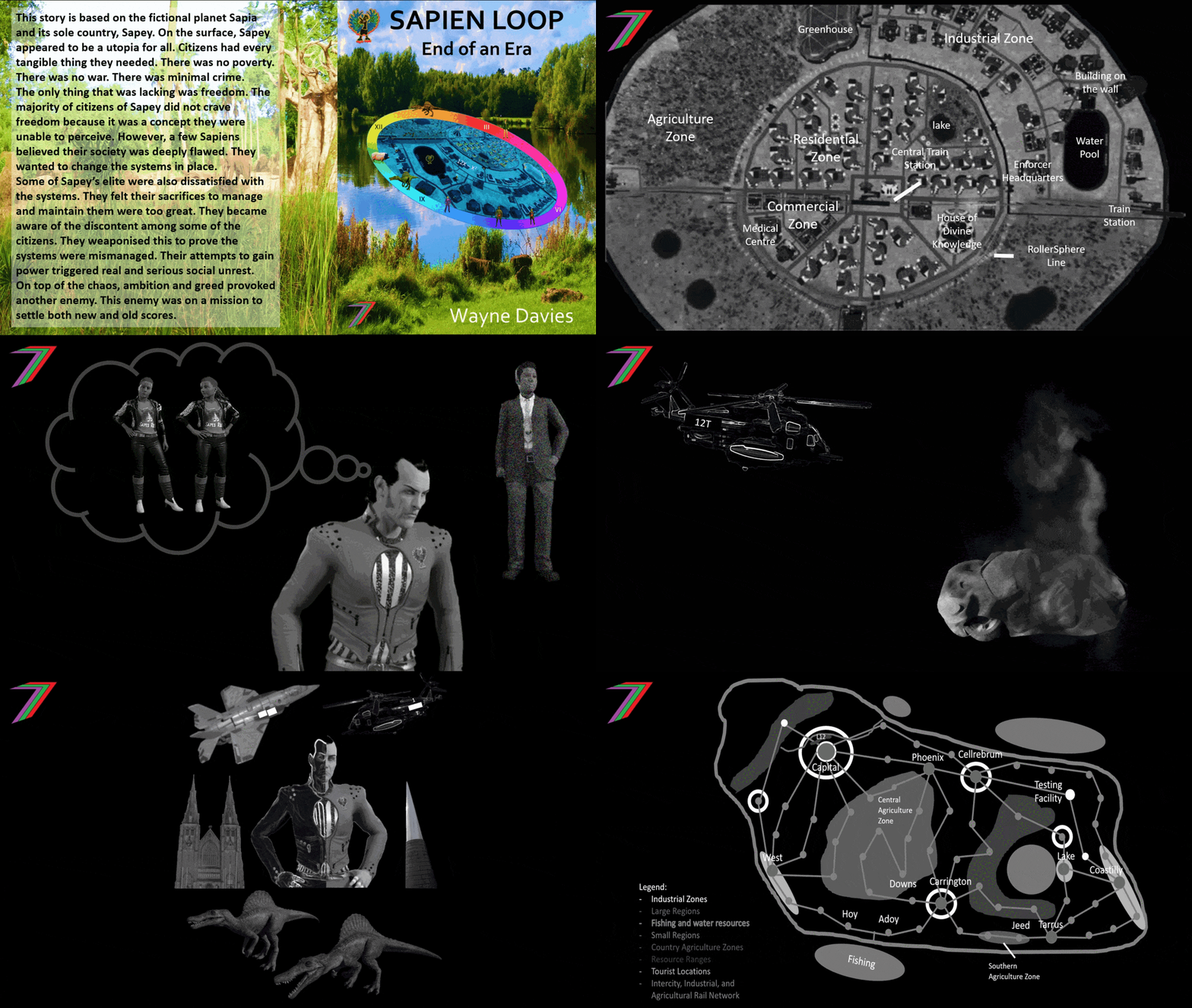
This story is based on the fictional planet Sapia and its sole country, Sapey. Sapey is portrayed as a form of utopia for all its citizens. No poverty. No war. Almost no crime. Opportunities for all.
This was enough for most citizens, but not all. In one of the small regions, some of the citizens had become discontent. They felt something important was missing in their lives. Their discontent did not go unnoticed. Some of the Sapey elite wanted to weaponise this discontent to gain more power. This created more chaos than they anticipated. This led to further widespread social unrest.
On top of the chaos, ambition and greed provoked another enemy. This enemy was on a mission to settle both new and old scores.
Brief Summary of Sapien Loop: Frozen in Time

This story is based six years after the original story. The Downs Region is still suffering from a serious health crisis caused by the contaminated water. The main characters are desperately trying to find a cure for the illness that has been caused by the water.
One of the main characters has discovered frozen humanoids in hidden chambers. It appears they have been frozen for a long time. These chambers connect to a vast network of tunnels. While exploring the tunnels, one of the frozen humanoids disappears. It appears he has been stolen.
The story takes a step back in time to tell the story of the frozen humanoids. How and why were they frozen? This part of the story also explains the fall of ancient Sapey and the birth of the Sapiens. Can those from the past be able to coexist with those from the present?
Brief Summary of Sapien Loop: Worlds Collide

Sapien Loop: Worlds Collide continues the story directly after the events of the second book. Orcilla and Yassmay continue their journey to find help. In doing so, they encounter a dissident group from the underground world.
Tiberius is secured as the puppet leader for the underground Linap. He is being used to control the surface world from the Downs Region. Tiberius is unhappy with this arrangement and desires to be fully in control.
Resistance has formed to take back the Downs Region from Tiberius and the underground Linap. They aim to turn the underground population against Tiberius. If that fails, their only hope is to join forces with the dissident group Orcilla and Yassmay encountered.
All worlds may be destined to collide. Will Sapey finally be free of tyranny, is it destined to be destroyed, or is it locked into another loop of oppression?
Hive: Future of Social Media

Spectrumecons on the Hive Blockchain

Democracy can definitely be manipulated by different factors
I can't say I don't know much about the politics in the UK, but I can say that people who are politicians share some sort of semblance in their way of life, mannerism and lifestyle. However I think because not all of them are deliberately inclined to harm the people, or the system. But we can definitely agree that they lie, cheat and hide a lot of propaganda and crazy stuff which they do in secret.
I think the fact that they obviously lie in an attempt to decieve people, is why a lot of people do not trust them.