Strait of Hormuz and the Iran War – Part 1: The Bogeyman of the Middle East

Hi Everyone,

The potential repercussions of the Iran war on the world are enormous. The impact could far exceed even the Russia-Ukraine war. I have written a two-part series of posts to explain the rationale behind the war from both Trump’s and the US and Global Establishments’ perspectives; they are not the same. I hypothesise the longer-term ramifications of the impact of the closure of the Strait of Hormuz, which will compound existing crises in the West.
In Part 1, I discuss Iran/Persia and its transformation to the Islamic Republic of Iran. I discuss how the West has exploited Iran over the past century. This includes the overthrowing of the Qajar Monarchy in 1921 and the overthrowing of the Government in the 1953 coup. After the 1979 revolution, the West, the US in particular, has designated Iran as the regional threat that they have used to bolster their presence and control in the region.
Focus on Iran
Iran, formerly known as Persia, has a very long history spanning thousands of years. There is an enormous amount of content that could be discussed. For the purpose of this post, I am briefly focusing on aspects of Iran’s religious and political ideology that I believe relevant to the current conflict.
Iran Centre of Shia Islam
Iran/Persia became a predominantly Muslim country between the eighth and tenth centuries. By the end of the eleventh century, the population of Iran/Persia was 90% Muslim (Transform). Iran’s conversion to Islam was slower than that of Lebanon’s, which took around only three decades. I discuss Lebanon in my post, Do You Strive to be Someone’s Pet? as a case study for how a predominantly Christian population can become Muslim in a matter of decades.
In the sixteenth century, under the Safavid dynasty, Iran/Persia officially became the centre of the Shia Islamic world (World History Edu). This made them a major rival to their Sunni Muslim neighbours, the Ottoman Empire in particular. The Safavid dynasty helped spread Shia Islam to other countries such as Azerbaijan, Iraq, and Lebanon.
The Safavid dynasty collapsed in 1722 and was replaced by the Qajar dynasty. Even under the new dynasty, Shia Islam remained the cornerstone of its national identity. The percentage of the population that was Muslim remained above 90% that entire time (Wikipedia).
Despite Persia’s Islamic identity, the people and the monarchy still honoured their pre-Islamic past. The Persian national flag and coat of arms during the Qajar dynasty had the symbol of the lion holding a sword with a sun peeking over its back.

The lion represents strength and power. It was originally linked to the Persian hero Rostam and later linked to Iman Ali (first Shia Iman). Thus linking ancient Persian culture to Shia Islam. The sword was added later and represents Ali’s sword. The sun represents the ancient Iranian god of light, Mithra (Symbol Sage).
The Age of Puppeteering and the Love of Oil
In 1921, with the help of the British military, Reza Khan led the Persian Cossack Brigade to overthrow Ahmad Shah Qajar and form his own Government. He forced the Qajar Government to appoint him as Minister of War and eventually Prime Minister. Over the next four years, Reza Khan suppressed tribal rebellions. After which, he finally deposed Ahmad Shah Qajar, and Reza Khan proclaimed himself the new Shah (Britannica).
The British Establishment wanted a Government they believed they could control because they wanted to control oil production and distribution. Anglo-Persian Oil Company (APOC), which was taken over by British Petroleum, benefited the most from this arrangement.
Reza Khan’s loyalty soon shifted away from the British Establishment to the new Nazi German Government. Dictator puppets are a little harder to maintain control over than ‘democratically’ elected ones, who can be pushed out with an election.
Germany was a European power that had not historically oppressed Iran. It had also become Iran’s largest trading partner. Forming a relationship with Germany also enabled Iran to take back control over its own oil supply. Nazi Germany’s ideology also appealed to Reza Khan, now calling himself Reza Pahlavi. He believed in Aryan race (The Lion and the Sun). This motivated him to officially change the name of his country from Persia to Iran. ‘Iran’ means ‘Land of the Aryans’. We could argue that Iran’s definition of ‘Aryan’ did not align with that of the Nazis. This did not get in the way of their alliance.
In 1941, Britain and the Soviet Union invaded Iran to regain control of the oil fields. In doing so, they overthrew Reza Khan and replaced him with his son Mohammad Khan (Pahlavi). Iran transitioned to a semi-constitutional parliament. This gave Mohammad Khan less power than his father had. In 1950, a nationalist coalition was elected to Government. Mohammad Mosaddegh became Iran’s new Prime Minister.
In 1951, the Government nationalised its oil industry. In 1953, the British and US Establishment orchestrated a coup to overthrow the Government. This was successful, and Mohammad Khan’s power was restored. In 1954, the oil industry went back under Western control, with British Petroleum controlling 40% and US companies controlling another 40% (Enclopedia Iranica).
Mohammad Khan also attempted to continue his father’s ambition of westernising Iran. This was unacceptable to many of the more conservative Shia Muslims. At the time, more than 95% of the population of Iran were Muslims, most of them Shia Muslims. Mohammad Khan did not like opposition to his ideology. He banned all opposition parties, ensuring that he could not be easily removed.
In 1957, he established the secret police, SAVAK. They used brutal tactics to repress dissenters. According to a Washington Post article, the SAVAK tortured and murdered at least tens of thousands of people. These were typically conservative Muslims (supporters of Ayatollah Khomeini) and socialists. The most notable incident was the 1963 Jaleh Square riots (Wikipedia).
Islamic Republic of Iran
Prolonged repression with no opportunity for peaceful resolution would ultimately lead to an uprising or even a revolution. In 1979, there was a revolution, and Mohammad Khan was overthrown. Iran went from Khan’s quasi-Western dystopia to a strict Islamic Republic. A huge swing from one extreme to another can be expected when a large proportion of the population has been repressed for a long time.
The ideology in the earlier years of the Islamic Republic of Iran was radical. Any forms of opposition to this new Islamic rule were treated ruthlessly. This involved arrests, executions, and forced exile. The majority of non-Muslims emigrated from Iran to other countries to escape this ideology. This further strengthened the grip of Shia Muslim ideology on the country.
Reinforcing Iran’s Shia Islamic Ideology
Iran developed a sophisticated political system. After the 1979 revolution, Iran held a referendum asking the people if they wanted the monarchy replaced by an Islamic Republic. The public overwhelmingly voted in favour of an Islamic Republic. Later that year, there was a second referendum. This referendum was to replace the existing constitution with one based on Islamic principles. The public also overwhelmingly voted in favour of it. The full Iranian constitution can be found on the University of Michigan Human Rights Library website.
Iran has executive, legislative, and judiciary branches and the Supreme Leader, who has overarching power over all three branches.
An elected president heads the executive branch. He selects his Council of Ministers, who are approved by the Islamic Consultative Assembly, which is the legislative branch (i.e., parliament). Their responsibilities include implementing policies, managing the economy, and foreign relations. The Supreme Leader maintains authority of the military, strategic decisions, and general oversight over executive branch decisions.
The Iranian Parliament (aka Majlis) consists of 290 elected representatives. Their responsibilities include enacting laws, approving the national budget, ratifying international treaties, and overseeing the executive branch. All legislation must be approved by the Guardian Council to ensure that it conforms to the constitution.
The Guardian Council consists of twelve appointed members. The Supreme Leader appoints six of them; these are Islamic clerics. The Chief Justice appoints the other six; these are jurists. The Supreme Leader appoints the Chief Justice, which is consistent with the constitution.
The Chief Justice is the head of the judiciary branch. He appoints all the judges, the head of the Supreme Court, and the General Prosecutor. The system is a hybrid of Islamic and civil law, which supports parallel court structures. These courts include public courts for general civil and criminal cases, revolutionary courts for offences against national security, special clerical courts to try clerics, and the Supreme Court for ensuring uniform legal application. The outcome of cases is determined by judges with the exception of cases relating to political and press offences.
The Iranian political system is built around their constitution and the authority of the Supreme Leader. The Supreme Leader is held to account by the assembly of experts. The assembly consists of 88 Islamic jurists who are elected by the public every eight years. The Guardian Council vets these candidates. The assembly of experts has the power to appoint and dismiss a Supreme Leader if they deem him unfit for his position.
The Iranian political system appears deeply centralised around the authority of the Supreme Leader. However, in reality this is unlikely to be the case. The Supreme Leader delegates much of his authority to others. They run the country in accordance with his ideology. When the Supreme Leader was killed, the country did not grind to a halt. Instead, it continued almost unhindered. Strategic military decisions were made with little delay.
After the 1979 Revolution, the Revolutionary Council (interim Government after the revolution) ordered the nationalisation of many industries. These included banks, insurance companies, medium and large-scale manufacturing, the oil industry, and agriculture industries (Iran Chamber Society). This approach closely resembles communist policies but differs in terms of ideology. The nationalisation process after the revolution served the main purpose of giving the Islamic State more power and control as well as preventing foreign Western interference.
The communists and socialists who played a key role in the revolution became the opposition to the new Islamic Government. This opposition was not tolerated. This led to arrests and executions. Many others were forced to flee or were exiled. The leading opposition to Iran’s Islamic Government leadership is the Mojahedin-e-Khalq, which has a combination of Islamic and Socialist ideology (International Socialist).
Iran’s political system, most notably its constitution, and its nationalisation of industries have offered it considerable protection from Western influence. The constitution and the architecture of the system blocks Western ideology and Western democracy from creeping in. Nationalisation of industry blocks Western ideology from infiltrating the country through commercial interference.
Many socialist/communist countries have used this approach to inhibit the growth of Western ideology and Western democratic values. However, these systems do not protect them from NGOs that have had some success in turning people against their leadership. The January 2026 riots are an example of the power of this influence.
Sources for the section: Study.com, PBS, and Google Search Engine summaries.
Rise of Sunni-Shia Tensions
The US (Establishment), which had taken over from the UK as the main western presence in the Middle East, was unable or unwilling to stop the revolution and the eventual overthrow of Mohammad Khan. It is possible that the US Establishment was willing to let go of their puppet in exchange for heightened tensions in the Middle East. The US Establishment could more easily convince the Gulf States to allow them to establish bases in their countries for the purpose of ‘security’. The real reason was to give the US Establishment greater control over the region (MERIP).
The US presence in the Middle East also served the purpose of stoking tensions between the Shia and Sunni Muslims. Historically there have been tensions between Sunni and Shia Muslims, but these had mostly diminished centuries ago (George Town University).
In 1980, Iraq invaded Iran. Iraqi leader Saddam Hussein wanted to capture Khuzestan because of its vast oil reserves. The US Establishment backed this invasion to stop the spread of the Shia Islamic Revolution to other parts of the region as well as reduce Iran’s control over the Persian Gulf’s oil reserves (YRIS).
Iraq was a predominantly Shia Muslim country (two-thirds of the population were Shia Muslims) led by a Sunni Muslim Government. It was quite possible that the war could cause an uprising in Iraq. US funding to Saddam Hussein would have played a role in preventing that from happening. The war evolved into one between Shia Islam (Iran) and Sunni Islam (Iraqi leadership) (Harvard Kennedy School). This ultimately increased tension between the two groups of Muslim faiths, which would have been a goal of the US Establishment.
The 2003 US invasion of Iraq was a huge trigger of tension between the Sunni and Shia Muslims. The fall of the Iraqi Government (Baathist Regime) led to a power vacuum in Iraq. These led to the creation of Sunni terrorist groups such as Al-Qaeda and ISIS as well as Shia militia groups. Thus enabling the most radical people from each side.
The Sunni-Shia divide enabled the US to spark civil war in Syria, which the US wanted to use to remove Bashar al-Assad (Modern Diplomacy). They finally succeeded in December 2024 when Assad was replaced by Hayat Tahrir al-Sham terrorist leader Abu Mohammad al-Jolani.
The civil wars in Lebanon and Yemen have further added to tensions between Sunni and Shia Muslims. The US-backed Saudi Arabia has heavily funded Sunni factions and terrorist groups to fight Shia factions and terrorist groups (Wikipedia).
The heightened tensions are used to permanently justify US presence in the Middle East. Saudi Arabia’s propagation of Wahhabism has led to the radicalisation of terrorist groups such as ISIS and Al-Qaeda. These groups have murdered hundreds of thousands of people across the world (Wikipedia). This far exceeds the numbers killed from Shia terrorism.
Figure 1: Deaths from terrorism by group, 2007–2025

Source: Vision of Humanity
The four deadliest terrorist groups over the past decade, JNIM, TTP, Al-Shabaab, and ISIS, are all Sunni Islamist groups. Over the past decade, Iran has actively fought against ISIS (the most deadly terrorist group in the world). For example, they funded the Popular Mobilization Force (PMF), which fought against and defeated ISIS in Iraq (PBS News).
The US has supported and contributed to the rise of ISIS. They did so through the 2003 invasion of Iraq and the funding of militant groups to remove Assad from power in Syria. One of those groups benefitting from US funding was ISIS (The Guardian).
History of Sanctions
After the 1979 Islamic Revolution, Mohammad Khan was given asylum in the US to receive cancer treatment. This decision enraged the people of Iran, who wanted the former Shah to face trial for his crimes against the people. Radical Islamist students stormed the US embassy in Tehran, taking 52 diplomats and US citizens hostage. The new leader of Iran, Ruhollah Khomeini, supported this action. The US responded by freezing $12 billion in Iranian assets. All the hostages were held for 444 days before being released. The US responded by unfreezing $8 billion in Iranian assets (Wikipedia).
The US has considered Iran under its Islamic Regime the enemy ever since. Keeping US hostages seems like an incredibly foolish move by Khomeini. This decision could have been based on how radical Iran was at that time, or there could have been something else motivating this decision.
In 1984, Iran was heavily sanctioned because of their financial and military support of Hezbollah in Lebanon during the civil war. As part of that war, Israel invaded Lebanon to fight the Palestinian Liberation Organisation (PLO). After Israel defeated the PLO, Israel decided to establish a buffer zone in Lebanon’s territory.
As expected, the Lebanese Shia Muslims who made up a large percentage of the population in the south could not tolerate Israel’s occupation of that territory. In response, Hezbollah was formed. Israel and Hezbollah were in conflict until 2000. The conflict ended when the Israel Defence Forces withdrew from Lebanon.
The sanctions did not stop. In 1996, the US added more sanctions based on claims that Iran was developing weapons of mass destruction. These sanctions ended all trade between the US and Iran.
From 2007 onwards, sanctions on Iran intensified. The reasons given relate to the extent of Iran’s uranium enrichment, which the UN Security Council feared could be used to build a nuclear weapon (Atlantic Council).
Sanctions between 2011 and 2013 severely hit Iran’s oil export market when the US targeted countries that bought Iranian oil. From 2011, the US sanctioned Iran’s Central Bank. This caused the crash of the Rial and hyperinflations as well as the loss of access to billions of dollars of assets in overseas banks (Atlantic Council). The inability to process payments caused supply chains for food and medicine to collapse (Peace Policy).
The sanctions have done little to hurt the Iranian leadership or prevented Iran from enriching uranium. However, the people of Iran have greatly suffered. The sanctions pushed millions of people into poverty. It contributed greatly to hyperinflation. It caused shortages of medical supplies that may have resulted in thousands of unnecessary deaths. Restrictions on technology that could have reduced pollution may have caused many more health problems and ultimately deaths. (National Library of Medicine and updated National Library of Medicine).
Even though the sanctions have greatly affected Iran, the Iranian Government has not done a great job of managing the economy. For example, the most recent crash in the Rial (Iran’s currency) could have been mitigated more effectively (e.g., a deal could have been made with China to buy Rial to reduce the extent of the crash). The crash of the Rial led to hyperinflation, which destroyed the purchasing power of the Iranian people, thus causing immediate hardships. This led to the protests in late December 2025 and January 2026.
The protests were mostly peaceful until they were infiltrated by agent provocateurs from US-based NGOs (Ron Paul Institute). This led to a bloodbath that lasted several days. According to Iranian authorities, 3117 people were killed; 2417 were civilians and security forces (e.g., police), and the rest, around 600, were terrorists/rioters. This is an incredibly high death toll for riots or even social unrest over such a short period. This arguably pushed Iran into crisis. The US responded by sending its navy to the Middle East to launch an attack.
Where is Iran Now?
What is Iran really like? What are the people like? What do these people believe? It is difficult to answer these questions honestly, because all Western media, both left and right-wing, portray the Iranian leadership as evil and the population as victims of this evil. Any social media influencers from Iran are also likely to be biased but in favour of Iran. Their bias is largely to counter the extreme propaganda against Iran.
In an attempt to be closer to objective, we should consider surveys and statistics. Even these can be biased by various factors, but this is about the best information an outsider can use to objectively assess what is happening and the sentiment in a country.
In 2023 and 2024, the Center for International & Security Studies at Maryland conducted a telephone survey in Iran regarding a variety of topics. In 2025, they conducted another survey after the twelve-day war. Both of these surveys used a sample of 1,000 Iranians. The margin error has been estimated to be +/-3.1%.
Answers to Questions from 2023 and 2024 Surveys
Opinions Regarding Iranian Officials


Opinions Regarding the US and the West


Opinions Regarding Palestinians and Israel


Opinions Regarding Approach to Military and Defence


Favourability Towards the US, China, and Russia


Source: Center For International & Security Studies at Maryland
This survey strongly suggests distrust of the US but also a willingness to coexist peacefully with the West. The Iranian people strongly support Palestinians and their causes and are unwilling to recognise Israel even if that meant reducing sanctions.
The Iranian people strongly support retaliation against any nations that attack them. Any form of military action would harden their views regarding their nuclear programme. However, through negotiations that would offer them sanction relief, they would be willing to accept limitations and monitoring of their country’s nuclear programme.
The Iranian people are considerably more favourable of China and Russia over the US. However, they do not support or want involvement in the Russia-Ukraine war.
Answers to Questions from Post Twelve-Day War Survey
Opinions Regarding Iran’s Response to the Twelve-Day War


Opinions Regarding Iran’s Economy


Opinions Regarding Religion and Politics in Iran


Opinions Regarding Iran’s Military and Nuclear Programmes


Happiness

Source: Center For International & Security Studies at Maryland
After the Twelve-Day War, the Iranian people were supportive of their military’s and Government’s response to Israel. They placed the blame for the attacks on the US and their influence on Israel.
The Iranian people are deeply unhappy about Iran’s economy. They mostly blame mismanagement and corruption, but they also put some of the blame on sanctions.
The survey indicates that the Iranian people are generally happy with both their President and Foreign Minister. They still strongly support Islamic teachings, but they are moving towards relaxing certain practices, such as wearing hijabs in public. The Iranian people are generally not afraid to voice their opinions in public, but some are still cautious. The economy is the greatest concern of the Iranian people, and they are least concerned about freedom.
The survey indicates that after the Twelve-Day War, Iranian people more strongly believe that Iran has to rely more on itself for defence and military capability. There is overwhelmingly strong support for their missile programme. More than half surveyed believe that Iran should develop a nuclear weapon. In another question, more than 50% surveyed believe Iran should expand its nuclear activities.
The majority of Iranians do not believe there should be further negotiations. If there were negotiations in the future, the Iranian people would not want their Government to concede in areas such as ballistic missiles, uranium enrichment activity, nuclear programme, and support for Axis groups.
Despite the war and economic hardships, the majority of Iranian people rate their level of life satisfaction to be at least reasonable.
The Twelve-Day War has strengthened the resolve of the Iranian people. They appear to have increased their support for their leadership and military. They have grown increasingly antagonistic towards the US, this making any future negotiations very difficult.
Statistics
Statistics can provide further insight into how a country functions and is run. For this section, statistics from a number of areas have been taken from the Our World in Data website.
Population Statistics


Iran’s population has steadily grown, more than doubling since the Islamic Revolution. Birth rates have fallen sharply since the mid-eighties. This is mostly because of increased availability of birth control, older marriage and increased female education (Misgav). Death rates have also fallen sharply.
Migration has made little difference and has remained relatively stable. Various groups fled after the Islamic Revolution, but it did not statistically affect overall population numbers. Despite economic hardships, vast numbers of people have not fled the country.
Economic Statistics


The Iranian economy has struggled in almost every aspect. GDP per capita has stagnated since 2011. Inflation has wildly fluctuated over the past fifty years, thus almost completely eroding the value of the Rial.
The country had some success in lifting people out of poverty in the 90s and 2000s. However, progress has halted over the past fifteen years.
Unemployment has been consistently high over the past forty years. This is particularly high for young people who are unable to enter the workforce. Female unemployment has been particularly high. This is because most of the skilled female workforce is younger and because males are culturally preferred in the workforce.
The effect of sanctions on the economy is notable. Iran’s growth noticeably halted after the heavy 2011 sanctions relating to energy and banking. Lack of growth in economic activity meant limited employment opportunities. This is reflected in the high unemployment and falling employment rate.
Healthcare


Despite Iran’s economic problems and sanctions that have restricted the import of medicine (Wikipedia), healthcare has improved in a number of areas. Iran’s life expectancy has climbed above world averages. Maternal and child mortality have plunged to levels equivalent to those of Western countries. Healthcare coverage is also on par with European countries. Deaths from poor sanitation have been reduced to almost zero.
The death rate from air pollution is well above Western standards. This is likely because Iran has been forced to use their own natural gas for only domestic consumption as well as have been denied cleaner energy technology (The Guardian). A possible solution is nuclear power. Iran has some uranium reserves it could mine.
Education


Since the 1979 Revolution, Iran has completely transformed its education system. From considerably below world average in every area of education, it has now far exceeded them. Almost every child is given a primary education. Around 95% of all children receive at least a lower secondary education, around 80% receive at least an upper secondary education, and around 60% receive a tertiary education.
Approximately 20% of Government spending is dedicated to education, which is considerably higher than the world average. The increased contribution to scientific and technical journals is an example of their vastly improved knowledge.
Iran’s biggest achievement in education might be its progress in educating females. Female literacy has increased from 36% in 1976 to 98.9% in 2025. Females make up 60% of university entrants and 70% of STEM graduates (Grokipedia).
Electoral Democracy Index

Iran scored very low on the Democracy Index. This is not surprising because the index is based on Western standards. The Supreme Leader is technically all-powerful and has yet to be removed or changed through any existing process in Iran. However, Iran still scored much higher than Saudi Arabia, where any form of democracy is non-existent. The index also assumes that elected Western leaders actually run their countries.
Military Spending

Iran’s military spending is relatively low. It is well below the 2.5% of NATO countries. This expenditure has been consistent for several decades. Almost two-thirds of this expenditure goes to the IRGC (Iran Open Data).
The official military receives very limited funding. The IRGC plays the biggest role in Iran’s military. They operate Iran’s ballistic missiles and most of their drones. These have become the most dangerous aspect of their military.
Part 1 Conclusion
Iran is a complex society. Not everyone is happy with how it functions. Their society suffers from a combination of mismanagement, corruption, and the persistent sanctions imposed on them.
Their religion is applied strictly, but less so than many of their Muslim neighbours. Limitations on freedom do not seem deeply resented by the majority of their people, as it aligns with their religion. Their culture is different from Western cultures. Most native Europeans would not tolerate it, but that should not matter as long as the Iranians do not impose their culture on European countries. Likewise, Europeans or their Governments should not impose their culture on Iran. It is sad that Iran and Iranians need to be villainised for Governments to maintain support for their actions.
The Sapien Loop Series
I have written a trilogy of books titled Sapien Loop. The first in the series is Sapien Loop: End of an Era, the second is Sapien Loop: Frozen in Time, and the third is Sapien Loop: Worlds Collide. I published the whole series as ebooks on Amazon, and I have posted completed chapters to my @captainhive
In 2025, I wrote a short stories book about some of the characters and their adventures. This book is now available on Amazon. I have also posted these stories to my @captainhive account.
Brief Summary of Sapien Loop: End of an Era
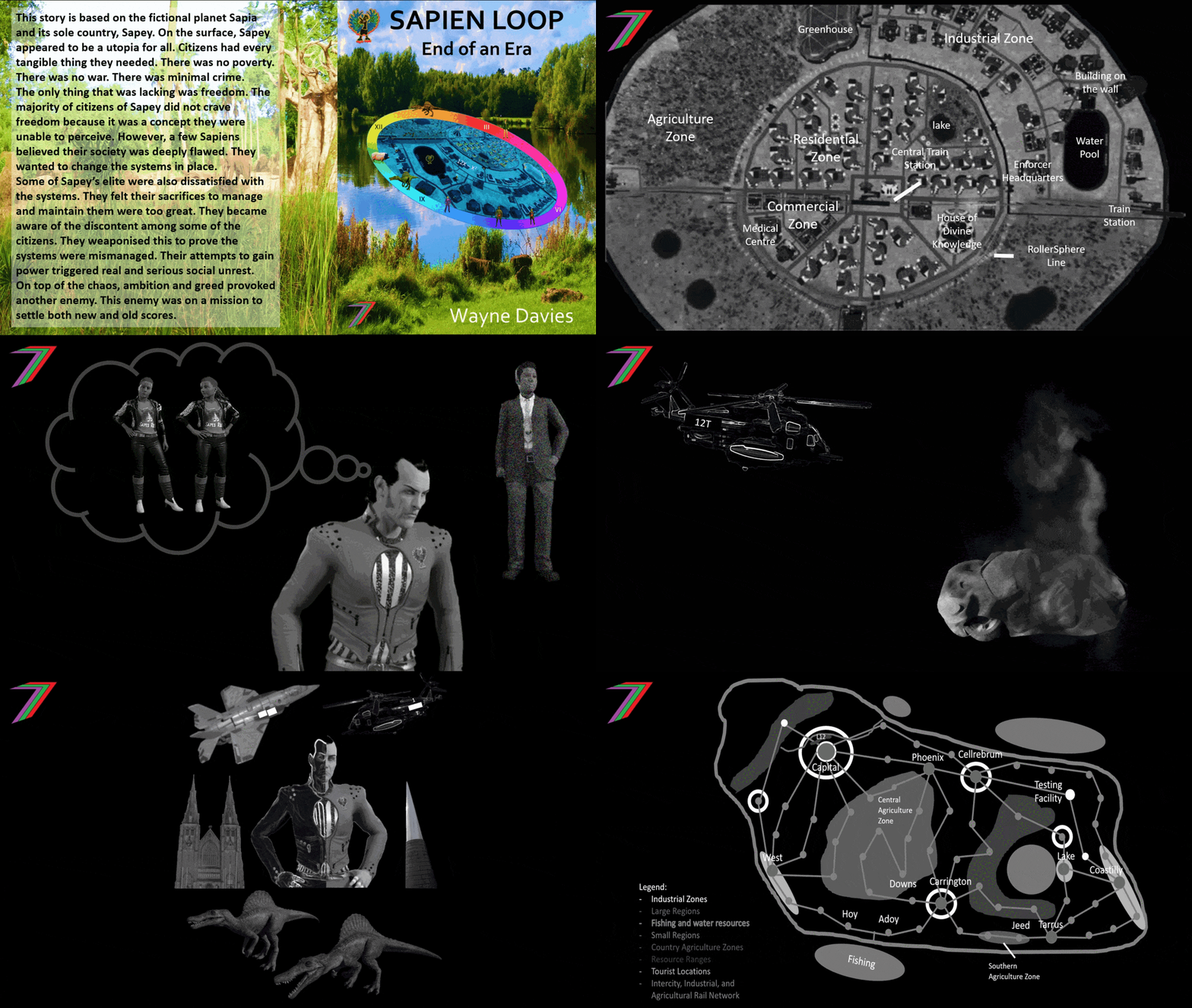
This story is based on the fictional planet Sapia and its sole country, Sapey. Sapey is portrayed as a form of utopia for all its citizens. No poverty. No war. Almost no crime. Opportunities for all.
This was enough for most citizens, but not all. In one of the small regions, some of the citizens had become discontent. They felt something important was missing in their lives. Their discontent did not go unnoticed. Some of the Sapey elite wanted to weaponise this discontent to gain more power. This created more chaos than they anticipated. This led to further widespread social unrest.
On top of the chaos, ambition and greed provoked another enemy. This enemy was on a mission to settle both new and old scores.
Brief Summary of Sapien Loop: Frozen in Time

This story is based six years after the original story. The Downs Region is still suffering from a serious health crisis caused by the contaminated water. The main characters are desperately trying to find a cure for the illness that has been caused by the water.
One of the main characters has discovered frozen humanoids in hidden chambers. It appears they have been frozen for a long time. These chambers connect to a vast network of tunnels. While exploring the tunnels, one of the frozen humanoids disappears. It appears he has been stolen.
The story takes a step back in time to tell the story of the frozen humanoids. How and why were they frozen? This part of the story also explains the fall of ancient Sapey and the birth of the Sapiens. Can those from the past be able to coexist with those from the present?
Brief Summary of Sapien Loop: Worlds Collide

Sapien Loop: Worlds Collide continues the story directly after the events of the second book. Orcilla and Yassmay continue their journey to find help. In doing so, they encounter a dissident group from the underground world.
Tiberius is secured as the puppet leader for the underground Linap. He is being used to control the surface world from the Downs Region. Tiberius is unhappy with this arrangement and desires to be fully in control.
Resistance has formed to take back the Downs Region from Tiberius and the underground Linap. They aim to turn the underground population against Tiberius. If that fails, their only hope is to join forces with the dissident group Orcilla and Yassmay encountered.
All worlds may be destined to collide. Will Sapey finally be free of tyranny, is it destined to be destroyed, or is it locked into another loop of oppression?
Hive: Future of Social Media

Spectrumecons on the Hive Blockchain

I love your history and analysis on this topic and you break every thing down to point to details and the complex of Iran society.
Thanks!
Interesting analysis but you are relying a lot on one US based telephone survey that could easily have been skewed by the Iranian government.
If the Iranian people DO generally support their government and hate Israel & the US as this survey indicates then there is no need to try to save them.
In that case Israel & the US should simply erase the entire infrastructure of the country and take it back to the Stone Age.
It is only because of of the high regard that Jews hold the Persian people that Iran still has infrastructure.
This high regard is because of the actions of Cyrus the Great 2500 years ago in allowing Jews to return to Jerusalem and rebuild The Temple.
There is also a general belief, fostered by the Persian diaspora, that the people of Iran are oppressed and don't like their government.
Also the extent to which Mossad has completely infiltrated Iran, including at the highest level, suggests that people aren't happy and are easy to recruit.
There is also the very rapid fertility drops - fastest in history - that indicate women are voting with their wombs.
So I'd say the preponderance of evidence is that the Persian people DON'T like their government and DO like Israel and the US.
But if I am wrong on this, and the continued failure of the Iranian people to overthrow their government is counter evidence then Trump should go through with his threat to erase Iranian civilisation.
We will see.
But the historical record of civilisations that lose wars and refuse to surrender is that they are erased. Japan in WWII, The South in US Civil War, 30 year war etc.
Thanks for your elaborate reply.
I relied on two surveys from the University of Maryland. Some of the survey results also include results from previous surveys. Surveys can definitely be biased in various different ways, e.g., sample selection and framing of questions. Even if that is the case, the results are unlikely to be completely wrong. That would involve a deliberate attempt to distort results over decades of surveys. I feel it is unlikely to be the case.
Some of the results indicate dissatisfaction with the Iranian Government. The people believe their economy is in a terrible state, and they put more blame on mismanagement and corruption than they do sanctions. They don't believe their government cares about how they feel. They feel women should not be confronted if they don't wear a hijab.
Outside of the survey there is evidence that people support their regime even if they are dissatisfied with many aspects of their Government.
There were huge turnouts for Khamenei's funeral. Al Jezeera claimed 12 million people in Tehran alone. That might be an exaggeration, but there is plenty of video footage from numerous sources showing vast numbers of people attending.
The voter turnout for the first and second rounds of voting in the presidential election was around 40% and 50%. Other elections, such as parliamentary and assembly of experts, are showing similar voter turnouts of 40%+. These numbers are low but similar to voter turnouts in recent UK elections. If support of the system were that dire, people would either not vote or the Iranian Government would force voting upon them.
There have been several occasions of unrest in Iran. One of the most significant being the unrest in 2022 over the death of a Kurdish woman who was arrested for not wearing a hijab. The unrest eventually ended. Since then, the Iranian government has loosened hijab enforcement. This aligns with the sentiments in the survey.
The Iranians have had 47 years to overthrow their leaders. It does not appear they have ever come that close. During the recent ceasefire, there has been no serious attempt to attack a weakened IRGC. The regular Iranian army has never attempted to attack the IRGC or rally the people to fight them.
I believe that Mossad has been able to infiltrate the Iranian Government because of the extent of corruption. I think this means that their loyalty can be bought.
Muslims in general stay loyal to their faith. That's why they have created so many problems in Europe because they want their Islamic culture to supersede existing European cultures. The Islamic Republic's constitution embodies the teachings of Islam and is consistent with their faith. The laws of the Islamic version of God over the laws of man. It is not compatible with democracy.
The Persian diaspora are people or descendants of people who fled Iran mostly in the 80s and 90s because of persecution. Most of them are not Muslim. Their family and the communities of their family who remain in Iran are likely to still face some form of persecution. However, they are only a small percentage of the overall population of Iran.
I don't think we can necessarily conclude that the majority of Iranians hate Israelis or Americans. The answers to one of the questions indicate that many Iranians want a peaceful coexistence with the West (not sure that includes Israel). Realistically, a peaceful coexistence does not look likely any time soon.
Interesting. A lot of conflicting data about the views of the Iranian people.
I've seen data suggesting that only 30% of Iranians are actually Shia Muslims and that there is a big move to atheism and Zorastriansim.
But ultimately the proof is in the pudding. If they don't overthrow their government after being given plenty of opportunity and support to do so they must be considered responsible for its actions and thus bear the consequences.
There has been a tendency in the West and Israel to say that X people are repressed by their government and are not responsible for its actions.
Israel has said it is at war with Hamas, not Gaza, with Hezbollah, not Lebanon, with the Iranian regime, not the Iranian people. The US has adopted a similar position.
I think this is fundamentally wrong with regard to Gaza, where Hamas and the Oct 7 atrocities had overwhelming support. Not a single Gazan helped a hostage escape and when they did escape the population handed them back to Hamas.
With Lebanon it appears that the distinction may be justified.
With Iran I think the distinction is looking less and less justified.
Ultimately the people in a country are responsible for the actions of their government, whether it is a democracy or not. They always have the power to change their government, even if that involves the use of force rather than just voting.
So unless there is clear evidence, like Lebanon where the government has formally agreed to Israeli occupation to remove Hizbollah, the country as a whole needs to be made to bear the price.
This means that complete destruction of Iranian infrastructure and use of tactical nuclear weapons to destroy Pikeaxe mountain needs to be on the agenda.
The West is being too soft and playing into victimhood narratives where people are not responsible for their actions or even inaction.
I think the 30% of Shia Muslim statistic more closely aligns with overseas Iranians. According to a survey, roughly 30% of American-Iranians identify as Muslim (PAAIA).
Mosque attendance in Iran is low. Some might argue that this is an indication that a considerably lower percentage of the population is actually Muslim. However, mosque attendance in Iran has been low for a long time. In 2006, less than 30% attended mosques weekly (Researchgate).
There are at least 6000 inactive mosques (Iranwire). Other sources are claiming as many as 50,000 are inactive/closed.
It looks like Iranians are moving towards more secular beliefs (Iran Academia Journals). It seems like a slow shift. I doubt there is enough urgency or anger to spark a revolution anytime soon. The next year or so will answer that question.