The Divine Messiah, Rabbi Akiva, and the Orthodox Contradiction: Why Yeshua as Fully Divine and Fully Human Is Not a “Foreign” Idea to Ancient Judaism

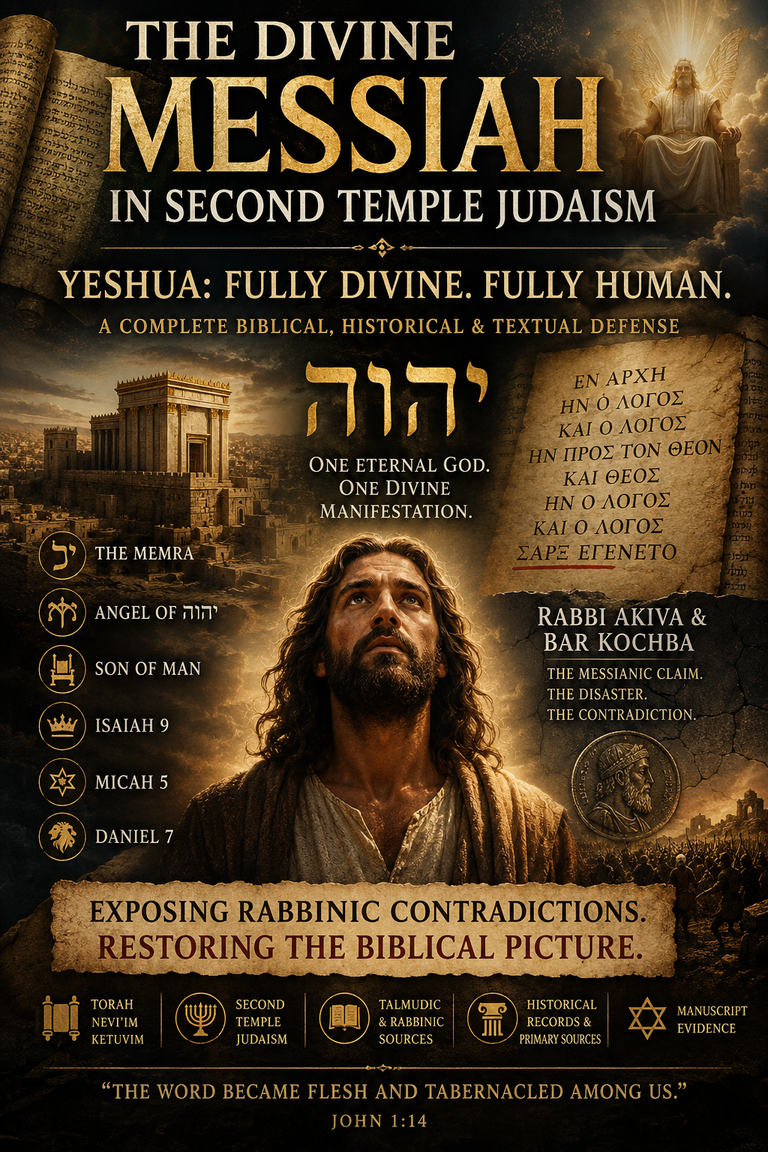
One of the most common objections raised by modern Orthodox Judaism against Yeshua as Mashiach is the claim that Messiah cannot possibly be divine.
The argument is usually framed like this:
“The Messiah must simply be a human king from the line of David. He cannot be יהוה. He cannot be divine. He cannot pre-exist. He cannot be the visible manifestation of the Eternal.”
At first, that argument sounds simple.
But once we examine the תורה, the Prophets, Second Temple Jewish thought, the Memra, the Angel of יהוה, Daniel’s “Son of Man,” and ancient Jewish concepts of divine manifestation, the issue becomes far more complex.
The real question is not whether יהוה is One.
The real question is:
Does the Hebrew Bible allow the Eternal to reveal Himself through visible, embodied, mediating manifestation while still remaining transcendent above creation?
The answer is yes.
And this is exactly where many modern Orthodox objections become historically and textually weak.
Modern Orthodox Judaism Is Not Identical to Second Temple Judaism
This must be understood first.
Modern Rabbinic Judaism is not the same thing as ancient Israelite religion, and it is not identical to the Judaism of the Second Temple period.
Second Temple Judaism was diverse.
There were:
Pharisees
Sadducees
Essenes
Zealots
priestly movements
apocalyptic groups
Enochic traditions
mystical traditions
different Messianic expectations
Jewish followers of Yeshua
After the destruction of the Second Temple in 70 AD, Jewish religious life had to be reconstructed without:
the Beit Hamikdash
the altar
the sacrificial system
active priestly administration
Modern scholarship openly recognizes this transition. TheTorah.com explains that after 70 CE, Jewish life was transformed from a Temple-centered system into a Judaism increasingly centered around sages, Torah study, halakhic interpretation, and rabbinic authority.
Rabbi Akiva became one of the most influential architects of post-Temple Rabbinic Judaism.
Jewish educational sources openly recognize that Akiva’s development occurred during the post-Temple reconstruction period when Rabbinic Judaism was taking shape.
Many ideas modern Orthodox Judaism now labels “foreign” or “Christian inventions” actually existed within Jewish thought before later Rabbinic consolidation.
The Memra — The Visible Expression of the Invisible God
One of the most important concepts in this discussion is the Memra.
The Aramaic word: מֵימְרָא
means: “Word.”
But within the Targumim, the Memra often functions as more than ordinary speech.
The Jewish Encyclopedia describes the Memra as “the Word,” particularly in the Targumic tradition, where it becomes associated with divine manifestation, divine activity, and the way the Eternal interacts with creation while avoiding direct anthropomorphic language.
The Memra therefore functions as:
the active manifestation of יהוה
the visible expression of divine action
the mediating presence of the Eternal
This becomes extremely important when reading the Gospel of Yochanan.
Yochanan opens with:
“In the beginning was the Word…”
This is not random Greek philosophy detached from Judaism.
This language fits directly into Jewish discussions about divine manifestation already present in the Second Temple world.
The Word is with God.
The Word is divine.
The Word becomes flesh.
The Word tabernacles among humanity.
That is deeply Jewish theological language.
“The Word Became Flesh” — Tabernacle Imagery
Yochanan says:
“And the Word became flesh and dwelt among us…”
The Greek term used for “dwelt” carries tabernacle imagery.
The idea is not that יהוה stopped being transcendent.
The idea is that the divine presence manifested among humanity.
This concept already existed in Jewish thought through:
the Shekinah
the Glory
the Angel of יהוה
the Memra
Wisdom traditions
heavenly mediator traditions
The Orthodox objection that “God cannot manifest visibly” becomes extremely difficult to maintain once these traditions are acknowledged.
The Angel of יהוה Problem
Modern anti-Messianic arguments often insist:
“יהוה cannot appear in embodied form.”
But the Torah repeatedly presents situations where the Angel of יהוה speaks as God Himself.
Examples include:
Genesis 16
Genesis 22
Exodus 3
Judges 13
In Exodus 3, the figure appears as the Angel of יהוה in the burning bush, yet the speaker identifies Himself as the God of Abraham, Isaac, and Jacob.
In Judges 13, Manoah says:
“We shall surely die, for we have seen God.”
Yet the figure encountered is the Angel of יהוה.
Even modern biblical scholarship acknowledges the complexity of these passages. The Angel of יהוה for example, sometimes speaks as messenger and other times as the Eternal Himself.
This creates a category within the Hebrew Scriptures where יהוה can be:
transcendent
visible
distinguishable
and yet unified
That is not polytheism.
That is manifestation theology.
Daniel 7 and the Heavenly Son of Man
Daniel 7 is one of the most devastating passages against the claim that ancient Judaism had no concept of a heavenly Messianic figure.
Daniel sees:
the Ancient of Days
and one “like a Son of Man” coming with the clouds of heaven
This figure:
approaches the Ancient of Days
receives dominion
receives authority
receives universal service
possesses an everlasting kingdom
The Aramaic term: פְּלַח (pelach)
used in Daniel 7:14 is heavily debated by scholars, but the passage unquestionably presents an exalted heavenly figure receiving universal authority.
This is why Yeshua’s repeated use of “Son of Man” language was so explosive within the Jewish world of His time.
He was invoking Danielic throne-room imagery.
Not merely saying: “I am human.”
Ezekiel 37 Does Not Refute Divine Messiah
A common Orthodox argument points to Ezekiel 37.
The text speaks about David ruling restored Israel.
From this, some conclude:
“Messiah must only be human.”
But Ezekiel 37 never explicitly says:
Messiah cannot possess divine nature
Messiah cannot pre-exist
Messiah cannot embody the Memra
Messiah cannot manifest the presence of יהוה
The passage simply describes a Davidic ruler over restored Israel.
Messianic believers fully affirm this.
Yeshua is presented as:
Son of David
heir to the throne
ruler over Israel
future king
The issue is whether the wider Scriptures allow a deeper divine dimension to Messiah.
And they clearly do.
Isaiah 9 and Divine Titles
Isaiah 9 describes the Messianic child using astonishing titles:
Wonderful Counselor
Mighty God
Everlasting Father
Prince of Peace
Attempts to reduce these titles into mere poetic exaggerations create major interpretive difficulties.
The passage presents an extraordinary ruler whose identity transcends ordinary kingship categories.
Even if someone argues these are royal throne names, the text still places the Davidic ruler within a framework of astonishing divine association.
Micah 5 and Pre-Existence Language
Micah 5 speaks of the ruler from Bethlehem:
“whose goings forth are from of old, from ancient days.”
This language extends far beyond ordinary birth language.
Modern Orthodox interpretation often attempts to reduce this entirely to ancient lineage language.
But the wording remains striking.
The ruler comes from Bethlehem, yet his origins are described in ancient terms.
Again: this does not force polytheism.
It forces complexity.
The Virgin Birth and the Genealogy Objection
One common objection says:
“Yeshua had no human father, therefore He cannot inherit Davidic lineage.”
But the Torah never explicitly says:
“Messiah must come through ordinary biological conception by a human father.”
That assumption is inserted into the text.
Second Temple Judaism already accepted supernatural intervention from יהוה.
Miraculous births already existed throughout biblical tradition:
Isaac
Samson
Samuel
The miraculous conception of Yeshua is presented as divine intervention, not contradiction.
Rabbinic Genealogical Development
Another important issue is that Rabbinic Judaism itself developed historically.
Ancient Israel strongly emphasized paternal tribal lineage.
Yet later Rabbinic Judaism increasingly emphasized maternal Jewish identity.
This demonstrates that Rabbinic systems themselves evolved after exile, catastrophe, and historical crisis.
Therefore it becomes inconsistent to argue:
“Our later Rabbinic interpretation is absolute and unchanged from Moses.”
Historically, Rabbinic Judaism developed over time.
That is simply historical reality.
Second Temple Literature Cannot Be Ignored
Modern Orthodox systems often dismiss Second Temple literature entirely whenever it supports Messianic readings favorable to Yeshua.
Yet the Brit-Ha-Chadasha itself repeatedly reflects Second Temple thought patterns.
Examples include:
Enochic imagery
heavenly throne scenes
Son of Man traditions
resurrection theology
angelology
cosmic warfare imagery
Even Jude directly references Enochic tradition.
This does not automatically make every Second Temple text Scripture.
But it absolutely proves these traditions mattered within the world of the apostles.
Biblical Archaeology Review discusses scholarly debates surrounding exalted Son of Man traditions in texts such as 1 Enoch and 4 Ezra, showing these concepts were already part of Jewish apocalyptic discourse before later Christianity developed.
That is historically significant.
The Zohar and Later Mysticism
Ironically, many modern Rabbinic traditions accept later mystical developments such as:
Kabbalah
medieval mysticism
the Zohar
while simultaneously dismissing much earlier Second Temple traditions that existed far closer to the apostolic world.
Modern scholarship generally associates the literary emergence of the Zohar with medieval Spain and Moses de León in the 13th century.
This creates another inconsistency.
Why are medieval mystical developments acceptable, while much earlier Second Temple traditions are dismissed whenever they support Messianic readings?
The Unity of יהוה Is Not Violated
Messianic belief does not require abandoning the unity of יהוה.
The issue is not multiple gods.
The issue is manifestation.
The Scriptures already present:
divine Glory
divine Presence
divine Word
divine Wisdom
the Angel of יהוה
heavenly throne manifestations
The idea that יהוה can reveal Himself through embodied manifestation is not foreign to the Tanakh.
Yeshua as the Embodied Memra
The clearest Messianic understanding is this:
Yeshua is not “another god.”
Yeshua is the embodied manifestation of the Memra of יהוה.
The visible expression of the invisible Eternal.
The divine presence tabernacling among humanity.
Fully divine in nature.
Fully human in incarnation.
This is why the Gospel language repeatedly emphasizes:
glory
tabernacling
heavenly descent
divine authority
pre-existence
Rabbi Akiva and the Bar Kokhba Disaster
One of the greatest historical problems for modern Rabbinic certainty is Rabbi Akiva himself.
Jerusalem Talmud Ta’anit 4:5 preserves the tradition that Rabbi Akiva identified Bar Koziba as:
“King Messiah.”
Rabbi Yohanan ben Torta responded:
“Akiva, grass will grow from your cheeks and still the Son of David will not have come.”
This tradition is preserved in multiple historical discussions of the Bar Kokhba revolt.
Bar Kokhba’s revolt ended catastrophically.
Cassius Dio describes devastating destruction throughout Judea, including destroyed villages, fortified places, and massive loss of life.
Modern scholarship debates the exact casualty figures, but the catastrophic nature of the revolt is unquestioned.
Yet Akiva remains one of the most revered authorities within Rabbinic Judaism.
This creates a serious historical contradiction.
The Orthodox Double Standard
Modern Orthodox polemics often reject Yeshua because:
He did not establish final world peace
He did not visibly rebuild the Temple
He did not defeat Rome
He did not complete all Messianic expectations immediately
But Bar Kokhba failed these same tests even more dramatically.
He did not:
bring redemption
establish peace
restore the kingdom permanently
rebuild the Temple
defeat Rome
And yet Rabbi Akiva proclaimed him Messiah.
This exposes a major double standard.
If belief in Yeshua invalidates Jewish identity, why does Akiva remain authoritative after proclaiming a failed Messiah?
Minim and Rabbinic Boundary Formation
After the destruction of the Temple and especially after the Bar Kokhba catastrophe, sectarian boundaries hardened.
The category: מינים (minim)
became increasingly important within Rabbinic polemics.
Scholars debate the exact identity of the minim in every context.
The strongest historical claim is not:
“Minim always means Christians.”
The strongest claim is:
Rabbinic Judaism developed mechanisms for excluding sectarian groups, and Jewish believers in Yeshua eventually became associated with these exclusionary categories.
Being labeled minim by later Rabbinic authorities does not automatically prove Jewish believers in Yeshua abandoned the God of Israel.
It proves they were rejected by the emerging Rabbinic establishment.
Those are not the same thing.
Jewish Believers in Yeshua Were Not Foreign Outsiders
The earliest followers of Yeshua were Jews.
They worshiped the God of Israel.
They read Torah and the Prophets.
They believed Yeshua was Mashiach.
They existed fully inside the Jewish world of the first century.
The later separation between Judaism and Christianity was a long historical process involving:
Roman politics
destruction of the Temple
Gentile expansion
Rabbinic consolidation
Bar Kokhba
sectarian boundary formation
Therefore the claim:
“Belief in Yeshua is automatically non-Jewish”
is historically false.
It reflects later Rabbinic boundary claims, not the original Second Temple setting.
The Genealogy Objection, Ruth the Moabitess, and the Orthodox Lineage Argument
One of the most common modern Orthodox objections against Yeshua as Mashiach concerns genealogy.
The argument is often framed like this:
“Messiah must be a direct biological descendant of David through the father. Since Yeshua had no human biological father, He cannot inherit Davidic lineage. Furthermore, His genealogy contains Ruth the Moabitess and Rahab, which creates additional problems for Messianic claims.”
At first glance, this argument sounds decisive.
But once the historical, textual, legal, and covenantal context is examined carefully, the issue becomes far more complicated than modern anti-Messianic polemics often admit.
And ironically, Rabbinic Judaism itself already developed complex interpretive solutions to preserve the legitimacy of Davidic ancestry through Ruth the Moabitess.
That point is extremely important.
The Torah Never Explicitly Says Messiah Must Be Conceived Through Ordinary Human Fatherhood
One major issue is that the Torah never explicitly states:
“Messiah must be conceived through ordinary biological reproduction by a human father.”
That specific requirement does not appear directly in the Hebrew Scriptures.
What the Scriptures do emphasize is:
Davidic connection
covenantal kingship
dynastic continuity
throne inheritance
royal legitimacy
But anti-Messianic arguments often move beyond what the text explicitly says and treat later assumptions as though they were direct Torah commandments.
That distinction matters enormously.
Because the claim:
“Messiah MUST have a normal biological human father”
is an interpretive inference, not an explicit Torah verse.
Ancient Israelite Lineage Was More Complex Than Modern Internet Polemics Suggest
Modern debates often oversimplify ancient Jewish lineage structures.
But biblical and Second Temple Jewish society already contained:
levirate marriage structures
covenant incorporation
legal inheritance systems
tribal preservation mechanisms
dynastic household identity
adoption-like legal realities
non-Israelite incorporation into covenant life
Lineage in the ancient world was not always reduced to simplistic modern genetic categories.
Dynastic legitimacy often involved:
legal standing
covenant status
household incorporation
recognized inheritance rights
This is important because anti-Messianic polemics frequently impose overly modern biological assumptions onto ancient covenant structures.
The Ruth Problem Creates a Major Difficulty for Simplistic Orthodox Arguments
One of the greatest problems for rigid anti-Messianic genealogy arguments is Ruth herself.
Ruth was a Moabitess.
Yet Ruth became:
the great-grandmother of King David
part of the Davidic line itself
fully integrated into Israel’s covenant story
This creates a major issue because Deuteronomy 23 states:
“No Ammonite or Moabite may enter the assembly of יהוה…”
At first glance, this appears devastating.
Yet the Hebrew Scriptures themselves preserve Ruth not as an outsider enemy, but as a righteous covenant figure whose loyalty, faithfulness, and covenant commitment become central to Davidic ancestry.
This forced later Rabbinic Judaism to wrestle seriously with the issue.
Rabbinic Judaism Itself Developed Interpretive Solutions for Ruth
This is extremely important.
Rabbinic tradition itself recognized the difficulty.
The Mishnah and Talmud preserve discussions attempting to reconcile Ruth’s inclusion within the Davidic line.
Babylonian Talmud Yevamot 76b–77a discusses the issue directly and preserves the argument that the Deuteronomy prohibition applied specifically to male Moabites, not Moabite women.
This rabbinic distinction became critically important because without it, Davidic legitimacy itself would become problematic.
That means Rabbinic Judaism itself had to use interpretive nuance to preserve the legitimacy of David’s ancestry.
This is devastating for simplistic anti-Messianic arguments because it proves the issue was never historically as simplistic as:
“Foreign ancestry automatically disqualifies Messianic legitimacy.”
If that were true in an absolute sense, David himself would face genealogical difficulty through Ruth.
Ruth Was Not Merely Tolerated — She Was Honored
The Book of Ruth does not present Ruth as a shameful exception hidden in embarrassment.
Quite the opposite.
Ruth becomes one of the most honored women in Israel’s history.
She demonstrates:
covenant loyalty
faithfulness
devotion to the God of Israel
identification with Israel’s people
Ruth famously declares:
“Your people shall be my people, and your God my God.”
The biblical narrative itself therefore emphasizes covenant incorporation and faithfulness, not ethnic exclusionism.
This becomes critically important in Messianic discussions because it demonstrates that covenant identity in Scripture is more profound than simplistic racial or tribal reductionism.
Rahab Creates Additional Complexity
Rahab introduces another major complication for rigid anti-Messianic polemics.
Rahab was:
a Canaanite woman
associated with Jericho
incorporated into Israel
preserved within Israel’s covenant story
According to the genealogies preserved in Matthew, Rahab also appears within the Messianic line.
This means the Davidic and Messianic line already contains:
covenant incorporation
outsider integration
redemptive inclusion
transformed identity through allegiance to the God of Israel
Again: the biblical picture becomes far more complex than simplistic ethnic reductionism.
The Orthodox Argument Often Depends on Later Rabbinic Assumptions
Another major issue is this:
Many modern anti-Messianic arguments rely heavily on later Rabbinic assumptions about lineage while presenting them as though they were explicit Torah statements.
But historically: Rabbinic Judaism itself evolved over time.
Ancient Israel strongly emphasized paternal tribal identity.
Yet later Rabbinic Judaism increasingly emphasized maternal Jewish identity for covenant continuity and legal certainty after exile, dispersion, persecution, and historical catastrophe.
That means even Rabbinic systems themselves developed historically.
This matters because anti-Messianic polemics often present later Rabbinic legal formulations as though they were identical to ancient biblical structures.
Historically, they were not always identical.
Miriam’s Genealogy and the Debate Over Luke
Another major issue concerns Miriam herself.
Many Messianic and Christian interpreters understand Luke’s genealogy as preserving Miriam’s Davidic ancestry, while Matthew preserves the royal/legal Davidic line through Yosef.
It is important to be historically honest here:
The Gospel text never explicitly states:
“This is Miriam’s genealogy.”
That conclusion remains interpretive and debated.
However, many interpreters argue Luke’s structure strongly differs from Matthew’s royal genealogy and may preserve biological family ancestry connected to Miriam.
The important point is not pretending the debate does not exist.
The important point is recognizing that ancient genealogical structures, dynastic legitimacy, and covenant lineage were already more complicated than modern internet polemics usually acknowledge.
Legal Lineage and Dynastic Legitimacy Matter
Another oversimplification in anti-Messianic polemics is the assumption that only direct biological transmission matters.
But ancient Near Eastern dynastic legitimacy often involved:
legal inheritance
household identity
covenant recognition
royal succession structures
Even within the Hebrew Bible itself, legal and covenantal identity frequently carried enormous significance.
This matters because Yosef’s role within the Davidic household structure cannot simply be dismissed as meaningless under ancient covenant frameworks.
Again: the issue is more historically complex than simplistic objections usually admit.
The Jeconiah Argument Is Also More Complicated Than Often Presented
Another famous anti-Messianic objection appeals to the curse on Jeconiah in Jeremiah 22.
The argument claims:
“No descendant of Jeconiah can sit on David’s throne.”
Yet the issue is debated even within biblical interpretation itself because later prophetic passages appear to restore hope to Jeconiah’s line.
For example: Haggai 2:23 speaks positively about Zerubbabel, Jeconiah’s descendant, calling him a chosen signet ring.
This creates significant interpretive complexity.
Again: the point is not pretending every issue is simplistic.
The point is that anti-Messianic arguments often present deeply debated interpretive questions as though they were completely settled and obvious.
Historically, they are not.
The Davidic Line Itself Already Contains Complexity
This is one of the most important conclusions.
The Davidic line already contains:
Tamar
Rahab
Ruth
Bathsheba
covenant outsiders
scandal
restoration
divine intervention
unexpected reversals
The Messianic line in Scripture repeatedly demonstrates that יהוה works through:
brokenness
outsider incorporation
covenant mercy
surprising providence
This pattern appears throughout biblical history.
That is not a weakness of the Messianic line.
It is part of the biblical narrative itself.
The Core Issue: Covenant, Kingship, and Divine Purpose
The real issue is not whether modern anti-Messianic polemics can construct rigid genealogical formulas after the fact.
The real issue is whether Yeshua fulfills the Messianic role presented throughout:
Torah
the Prophets
Second Temple expectation
resurrection hope
heavenly Son of Man imagery
divine mediation themes
Davidic kingship
covenant restoration
And once those categories are examined together, the simplistic claim:
“Yeshua cannot be Messiah because of genealogy”
becomes far weaker than modern Orthodox polemics often suggest.
The genealogy objection sounds powerful only when enormous assumptions are inserted into the discussion without scrutiny.
But the moment we examine:
Ruth the Moabitess
Rahab
covenant incorporation
Rabbinic interpretation
dynastic legitimacy
legal inheritance
Second Temple Jewish complexity
Miriam genealogy debates
Jeconiah discussions
ancient lineage structures
the issue becomes far more complicated than simplistic anti-Messianic arguments usually admit.
Ironically, Rabbinic Judaism itself already had to develop nuanced interpretive solutions to preserve the legitimacy of Davidic ancestry through Ruth.
That fact alone proves ancient Jewish genealogy discussions were never as simplistic as many modern polemics pretend.
The biblical story itself repeatedly demonstrates that יהוה works through:
unexpected people
covenant outsiders
miraculous intervention
divine providence
and redemptive incorporation.
That pattern does not weaken the Messianic claim.
It strengthens it.
Conclusion
The claim that belief in a divine-human Mashiach is “un-Jewish” collapses under serious historical examination.
Second Temple Judaism already contained:
exalted Messianic expectations
divine manifestation concepts
heavenly mediator traditions
Son of Man theology
Memra theology
complex readings of divine presence
The Torah and Prophets do not forbid the possibility of Mashiach being both divine and human.
Modern Orthodox objections often rely more on later Rabbinic assumptions than on the plain text itself.
Meanwhile:
Daniel 7
Isaiah 9
Micah 5
the Angel of יהוה traditions
the Memra concept
Second Temple apocalyptic literature
all point toward a far more profound Messianic picture than merely:
“an ordinary human ruler.”
Yeshua fulfills the role of:
Son of David
heavenly Son of Man
divine mediator
High Priest
embodied Memra of יהוה
Not as a contradiction to Jewish thought.
But as the fulfillment of some of the deepest currents already flowing through the world of Second Temple Judaism.