Multi-Tiered Society – Part 2: The Real Multi-tiered Society

Hi Everyone,

In Part 2, I discuss what I believe more closely resembles the multi-tiered society that we live in. Most of the content of this post is theoretical and aligns with what can be observed and proven to a certain extent in reality. However, it is not definitively accurate. Complete accuracy is impossible given the covert nature of many of the actors running the system. I can guarantee that what I describe is considerably more accurate than the versions of our systems that the mainstream media wish us to believe; see Part 1.
The Real Multi-tiered Society
We have always lived in a multi-tiered society. Division based on race, religion, and culture is a tool to keep the people divided from each other so that they miss the relevant lines of division in society. The real division in society is linked to class. Ironically, class division was fundamental to the original split between ‘right-wing’ and ‘left-wing’ ideologies.
Class division has become considerably more complex than the original struggle and has become far less transparent. Many people are still unaccepting of class differences, but this has been overshadowed by manipulated differences based on race, religion, and culture.
Class is typically divided into upper, middle, and working classes. These three categories oversimplify the relevance of division by class. Society does not strictly divide along the lines of the three classes. It is much more intricate. The most relevant division is within the upper class. I would argue that the upper class should be divided into elite, executive, and celebrity classes. I define them as follows:
The elite class consists of the most influential and powerful in society, particularly bloodlines such as former royalty and family empires. It is not clear which families have the most power, but they probably include the Soros and Rothschild families.
The executive class consists of the financially wealthiest in society, such as wealthy business owners, landowners, bankers, and some in the political establishments. We could strongly argue that the executive class could be divided several more times. Some in this class are very close to the elite class in terms of power, and some are just very highly salary-paid executives.
The celebrity class consists of famous people such as actors, musicians, professional athletes, journalists, religious leaders, and most politicians. This class is more open to people outside of the upper class to join. This class is also the most vulnerable. If they fall out of line, they often pay a heavy price. Both the executive and elite classes control the celebrity class.
The middle and working classes are distinct from each other but are both treated with the same disdain by the three upper classes.
Roles within the Establishment
The elite, executive, and celebrity classes separate themselves from the middle and working classes through their positions in the Establishment, which gives them both power and wealth.
The elite class have the power to help reward both the executive and celebrity classes for their obedience and punish them when they do not perform as expected.
The primary focus of the elite class is strategic and long-term gains. Their main aim is to expand their control. This is both within their own countries as well as globally. They control various areas of the Establishment (Government, Banks, Big Business, Media, and Religious Institutions).
The executive and celebrity classes operate within the Establishment. The executive class has considerable control over decisions that support the strategic direction set by the elite class. Most people in the celebrity class do not make any decisions of any significance. Their main job is to promote agendas proposed by the executive class.
Government
The politicians that rise to high positions within Government (i.e., ministers) are from the celebrity class. An important aspect of their jobs is to promote initiatives that support agendas that benefit both the elite and executive classes as beneficial to the public. Politicians are easy to control because of the influence of elite and executive classes over other areas of the Establishment such as the media, as well as the two-party/two-ideology political systems.
The businesses owned by the executive class benefit from the transfer of wealth through Government initiatives, subsidies, and contracts. They also benefit from laws, regulations, and policies that reduce competition, which gives them greater monopoly power over customers and monopsony power over labour in the long run. Fewer businesses enable the elite class to control them more easily.
Governments make laws, regulations, and policies that help the elite class fund initiatives using the wealth of working populations. For example, mega-asset management companies such as Blackrock control public pension funds. This amounts to trillions of dollars that can be invested in any assets. This can be easily used to manipulate markets to the advantage of the elite classes.
The elite class benefit from Government foreign policy that forces other countries to open their markets. This could be through pressure from sanctions or military threats. If that does not work, actual military action can be used. Military action can force other countries to change leadership to one more accommodating to the Governments that the elite control. Even if leadership is difficult to change, they are usually able to induce another country to act in a particular way that supports the elite’s long-term agendas.
The Western-style 'democratic' system has become one of the elite class’ most effective weapons. It has allowed them to hold significant power while their puppet politicians face public scrutiny. The ideologies of ‘right’ and ‘left’ allow them to push their agendas from different angles. It has created the illusion of choice, which has greatly reduced resistance from the people. The media and NGOs have helped them spread democracy around the world. This has helped the elite gain significant power in all the countries that have adopted the Western-style democratic system.
Banks
The banks control the money supply. The Government borrows money by selling bonds to predominantly private banks, financial institutions, and asset management companies. In return, the Government pays them interest on the bonds. Eventually, the Central Bank buys the bonds from the largest banks and financial institutions with newly created money. The Government now owes the Central Bank money for merely creating money out of nothing.
The private banks can use the newly created money to invest in other assets or buy more bonds. Thus, increasing the flow of money to the Government while increasing its debt. Private banks are not limited to just buying bonds from their own Governments. They buy from other private banks as well as foreign Governments.
Bond interest provides significant revenue to private banks, which are predominantly owned by both elite and executive classes. The majority of the newly created money is controlled or owned by the elite and executive classes through the banking system. As more money circulates, the value is diluted. Prices of goods and services increase (inflation). This reduces people’s wealth, as they cannot buy as much as they previously could with the same amount of money. The US is partially protected from inflation because the US dollar is the world’s reserve currency and therefore in high demand.
The US Government can use the US dollar's reserve currency status to attack other countries by isolating them from the global financial system. This is an effective method of threatening and influencing Governments, which are not tightly controlled by the elite class.
The development of digital currency might become the elite class’ most powerful form of control mechanism. People can keep physical currency out of the financial system. Whereas digital currency is completely held within the system. It is just numbers on a screen.
People will only be able to use the digital currency for transactions. They will not be able to withdraw money from the system. This potentially allows banks complete control over everyone’s money. If the digital currency is programmable, the banks and the Government can limit how people use their money. This helps ensure money is spent in accordance with their goals.
Big Business
A key goal of the elite class is predominant control over production and distribution of goods and services. The most important areas of control relate to energy, food, water, and minerals. These areas greatly affect quality of life and even survival.
The elite class have achieved this by controlling the largest businesses and destroying the smaller businesses. Fewer larger businesses are easier to control than many smaller businesses. The elites enable the larger businesses to grow larger by influencing Government policies, intervention and contracts. They also use asset management companies to fund selected companies they wish to expand. They trigger economic events or other crises (e.g., the Covid shutdowns and the closure of Straits of Hormuz) that force smaller businesses to fail so that the large businesses can take over them.
Both the elite and executive classes control the largest businesses.
The elite class work with the executive class to achieve their strategic goals, and the executive class benefit from profits and/or exorbitant salaries.
The roles of the elite class and executive class vary considerably. The elite class have broader strategic control in terms of direction of these businesses (e.g., members on the board of directors of parent companies or asset management companies). This could involve the development of technology, maintaining and establishing supply chains, and the sources of resources and labour. The executive class controls the daily operations of these companies (e.g., CEO, COO, or even board members).
The elite class are able to control the executive class because they can threaten the executive class’ wealth. They can use their control over the Government to jeopardise contracts and/or subsidies to particular companies. They push the Government to pursue legal action against companies for breaking competition laws or worse. They can sell off the vast number of shares owned by the asset management companies they control. They can attack individuals personally by revealing scandals or using the media to fabricate scandals through rumours. Most billionaires have the vast majority of their wealth held in assets. The fear of these assets losing their value keeps the executive class in line.
Media
The executive and celebrity classes run the media. The executive class owns almost all the largest media parent companies and social media companies. This is very similar to how most other industries are controlled as described in the ‘Big Business’ section of this post.
Media plays a critical role in spreading information. Information is critical, as it influences what people believe to be true and what is important. Those spreading the information belong to the celebrity class. These include journalists, activists, actors, comedians, and musicians. Many at the top of their profession are rewarded with fame and wealth.
The media spreads information in various different ways. This can be done directly or indirectly. The direct approach is through news programmes that report selected events to the public. The indirect approach is through entertainment programmes that focus on particular topics that the Establishment wants pushed to the forefront of our minds.
Major social media sites such as X, Facebook, and TickTock use algorithms to promote content tailored to various demographics; this is to promote information and ideology that reinforces the beliefs of those observing the content. The algorithms also favour certain content creators that the Establishment wishes to push. This is because their content aligns with the messages that the Establishment wants to send to different demographics.
The media is also used as a powerful control mechanism for the elite class over both the executive and celebrity classes. The media can be used to destroy the reputations of anyone and any company very quickly. The celebrity class is most at risk because they rely so heavily on their fame. The most at risk are often politicians who have often only risen to their status because of the secret information that the executive and elite classes have against them. The Epstein files are an example of the sordid behaviour many in the celebrity class want to remain secret.
Religious Institutions
Religious institutions do not appear as influential in Western society as they have in the past. However, religion has played fundamentally the largest role in shaping societies around the world. Western democracy was strongly influenced by Protestant values. The entire political systems of most Muslim countries are anchored by interpretation of the Islamic faith.
Religion is more powerful than the media, as it is core to people’s ideology. People’s ideology determines how they process everything they encounter. It is often ingrained so deep within people that nothing else can influence them to change their perspective.
The elite of the past determined which religions thrived and which failed. In the fourth century, the Roman Empire, through the influence of its emperors (the elite of that time), adopted Christianity as its official religion. It used its size and power to rapidly spread the Christian faith around the world. In the seventh century, the Muslim caliphates' military conquests led to the rapid spread of Islam in a similar manner to how the Romans spread Christianity.
The liberalising of Christianity has reduced its direct influence over people. However, Islam has maintained a strong grip over its followers and has a considerably stronger ideological power. It does not appear that many elites directly control Islam. The elites have attempted to exert control over Islamic populations in the Middle East by elevating selected families to become royalty over newly created Middle Eastern countries. These families have become exceedingly rich through the sale of their country's oil and natural gas.
These new royal families cannot be considered part of the elite class, as their wealth and status are vulnerable to both Western elites and executive classes. The Iran War has strongly demonstrated their vulnerability. We could argue they are a hybrid of both celebrity and executive classes. They have the fame of the celebrity class and the enormous wealth accumulation of the executive class. However, they do not have broad leverage over the Establishment as a whole like the elite class.
It appears we are heading towards a predominantly Islamic world; this is by design. Islam provides the elites with a stronger ideology than Christianity. This enables the elites to move away from democracy to a more direct form of control, which they believe will be tolerated by a predominantly Islamic population.
Middle Class and Working Class
The vast majority of people fall into the middle and working classes.
The middle class are typically viewed as wealthier than the working class. However, this is not always true. Most of the middle class in Western countries are paid employees well below upper management. This places a cap on the amount of wealth they can accrue. Much of the income of the middle class is spent servicing debt such as student loans, mortgages, and credit cards. They also have expectations of an improving standard of living, which causes them to overspend and increase their debt further. The middle class generally earn above the income threshold for Government financial assistance. They also pay a higher percentage of their income in tax. Middle class families are slaves to debt and forced to keep all adults in paid work.
The working class can enter employment earlier than the middle class through apprenticeship positions. This allows them to earn an income instead of acquiring debt from a university degree. The working class can become small business owners and tradesmen. This has the potential to grow wealth, but they are often restricted by time, as they rarely grow big enough to grow a large workforce. Their livelihood is frequently under attack by Government policy that favours large businesses, which are able to more easily comply with them. This forces much of the working class into paid employment with a very low ceiling to their salary. Many in the working class cannot escape poverty.
Many lower middle class families are slipping towards poverty. It appears it will not be long before, in terms of quality of life, the middle and working classes will have merged into the same class. This is what the three upper classes want. This will enable them to create a form of socialism for the majority while they enjoy a far higher standard of living. We could call this form of political ideology ‘Plutocratic Socialism’ with elements of ‘Corporatocracy’. Read my posts, Exploring the Political Spectrum (Octagon Model) and Splitting the Political Spectrum into Social and Economic for a better idea of political models.
Conclusion
We live in a multi-tiered society. The divisions provoked between races, religions, and cultures are temporary divisions that function to turn populations against each other; they will remain until they have served their purposes. One critical and traditional purpose is masking the true division based on the classes described in this post.
However, the current drive to divide society has a much more significant long-term purpose, which is to play a key role in the collapse of most Western countries. After the collapse, new systems will be introduced, which will enhance the power of the elites controlling the Establishment.
The content discussed in this post appears complex, but it has taken the elite and executive classes centuries to develop and perfect.
The Sapien Loop Series
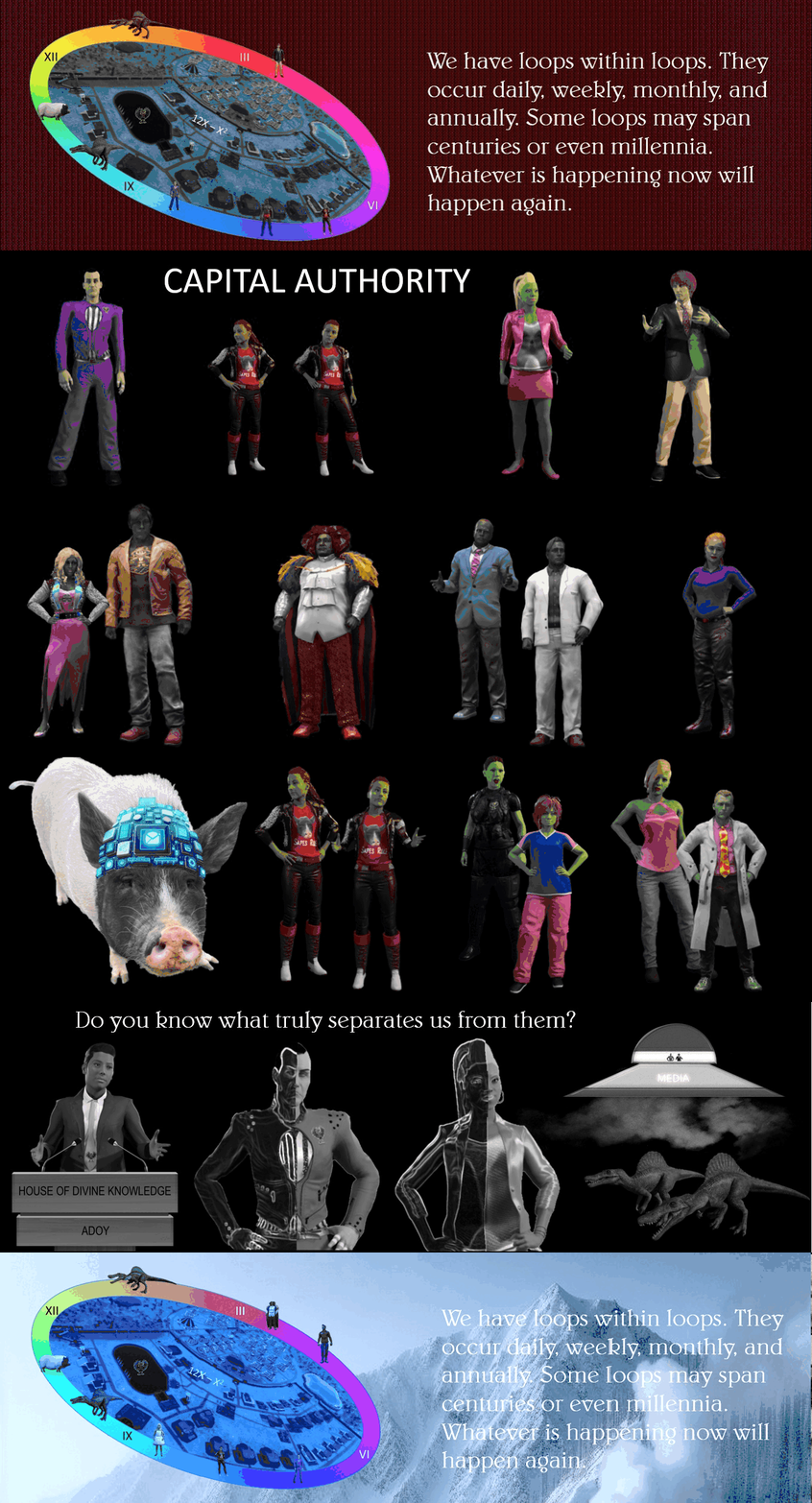
I have written a trilogy of books titled Sapien Loop. The first in the series is Sapien Loop: End of an Era, the second is Sapien Loop: Frozen in Time, and the third is Sapien Loop: Worlds Collide. I published the whole series as ebooks on Amazon, and I have posted completed chapters to my @captainhive
In 2025, I wrote a short stories book about some of the characters and their adventures. This book is now available on Amazon. I have also posted these stories to my @captainhive account.
Brief Summary of Sapien Loop: End of an Era
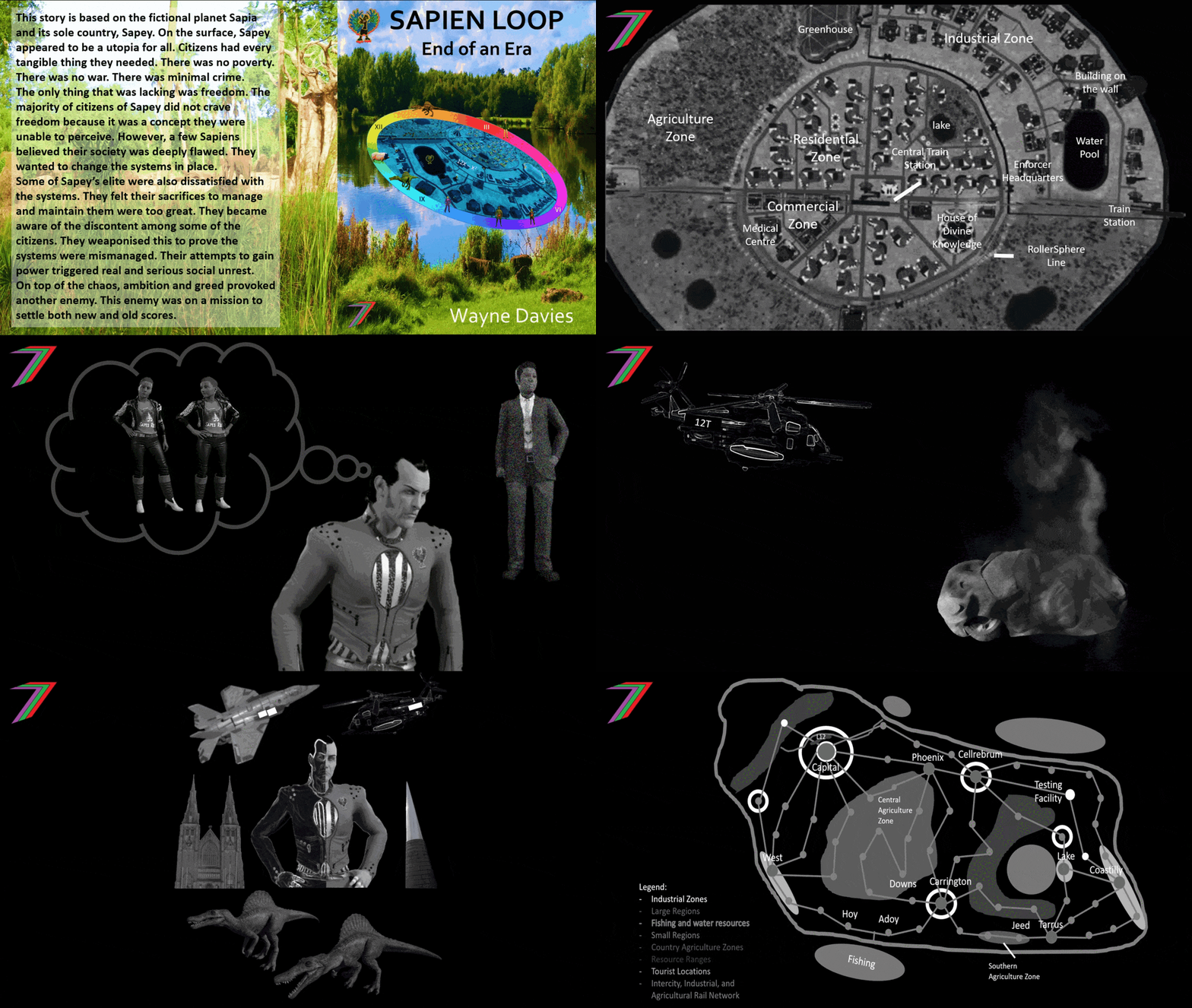
This story is based on the fictional planet Sapia and its sole country, Sapey. Sapey is portrayed as a form of utopia for all its citizens. No poverty. No war. Almost no crime. Opportunities for all.
This was enough for most citizens, but not all. In one of the small regions, some of the citizens had become discontent. They felt something important was missing in their lives. Their discontent did not go unnoticed. Some of the Sapey elite wanted to weaponise this discontent to gain more power. This created more chaos than they anticipated. This led to further widespread social unrest.
On top of the chaos, ambition and greed provoked another enemy. This enemy was on a mission to settle both new and old scores.
Brief Summary of Sapien Loop: Frozen in Time
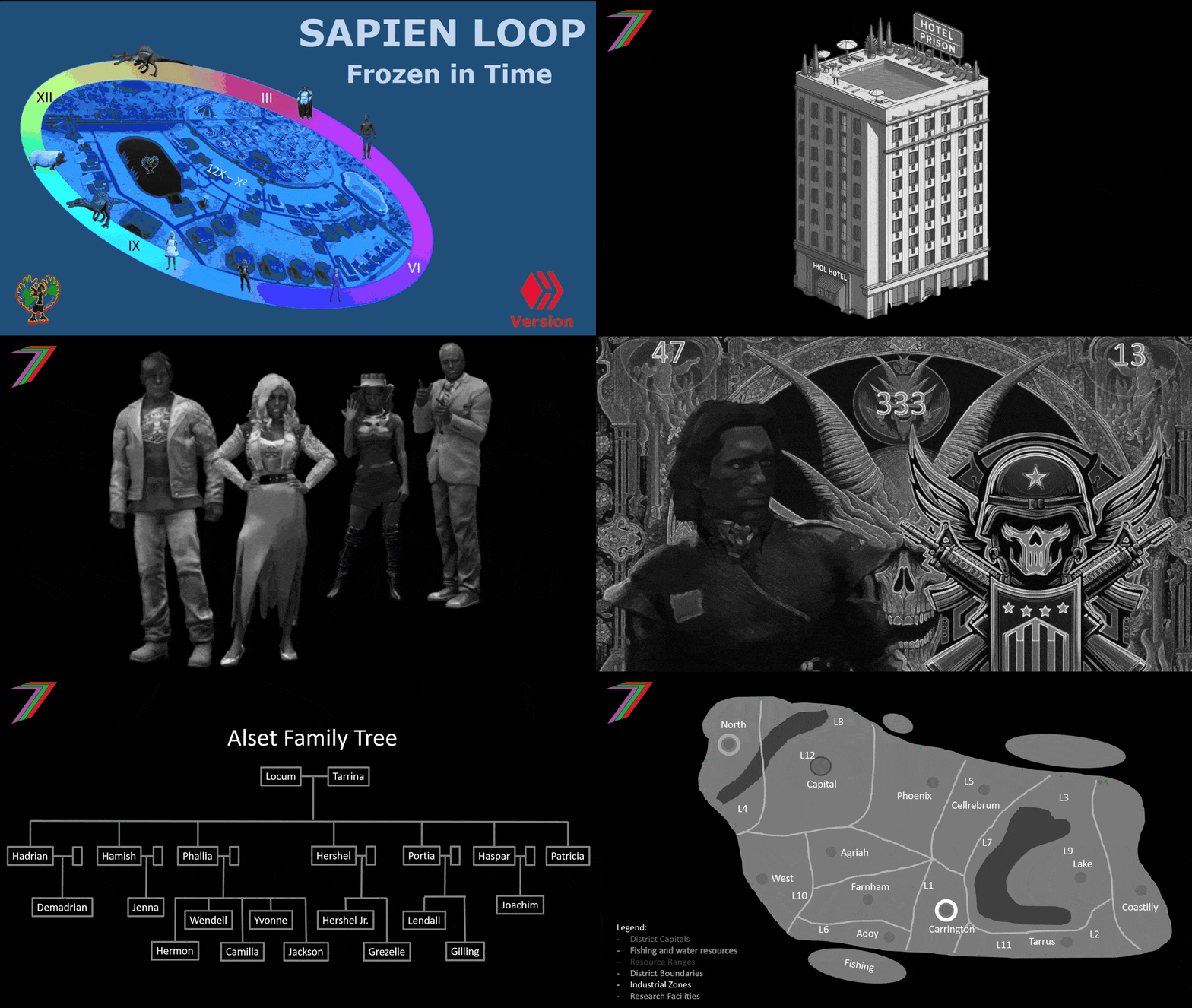
This story is based six years after the original story. The Downs Region is still suffering from a serious health crisis caused by the contaminated water. The main characters are desperately trying to find a cure for the illness that has been caused by the water.
One of the main characters has discovered frozen humanoids in hidden chambers. It appears they have been frozen for a long time. These chambers connect to a vast network of tunnels. While exploring the tunnels, one of the frozen humanoids disappears. It appears he has been stolen.
The story takes a step back in time to tell the story of the frozen humanoids. How and why were they frozen? This part of the story also explains the fall of ancient Sapey and the birth of the Sapiens. Can those from the past be able to coexist with those from the present?
Brief Summary of Sapien Loop: Worlds Collide

Sapien Loop: Worlds Collide continues the story directly after the events of the second book. Orcilla and Yassmay continue their journey to find help. In doing so, they encounter a dissident group from the underground world.
Tiberius is secured as the puppet leader for the underground Linap. He is being used to control the surface world from the Downs Region. Tiberius is unhappy with this arrangement and desires to be fully in control.
Resistance has formed to take back the Downs Region from Tiberius and the underground Linap. They aim to turn the underground population against Tiberius. If that fails, their only hope is to join forces with the dissident group Orcilla and Yassmay encountered.
All worlds may be destined to collide. Will Sapey finally be free of tyranny, is it destined to be destroyed, or is it locked into another loop of oppression?
Hive: Future of Social Media
Spectrumecons on the Hive Blockchain

The idea of digital money becoming a control tool is interesting, especially if it becomes programmable
If digital money becomes universal, we could lose complete control over wealth, savings, and purchasing power.
This post has been manually curated by @steemflow from Indiaunited community. Join us on our Discord Server.
Do you know that you can earn a passive income by delegating to @indiaunited. We share more than 100 % of the curation rewards with the delegators in the form of IUC tokens.
Here are some handy links for delegations: 100HP, 250HP, 500HP, 1000HP.
100% of the rewards from this comment goes to the curator for their manual curation efforts. Please encourage the curator @steemflow by upvoting this comment and support the community by voting the posts made by @indiaunited.
Great read. In reality, I think the elites and the top class also does something, and that's make sure the the society continues to remain tiered. The working class makes a lot of effort to get to a better tier, but most times, they can't because the system just makes it very difficult. They work to feed, pay bills and never really get enough to get financial stability.
I think the finance and economic tier system in the world is unfair to those at the lower end of the spectrum, and honestly the people at the top will keep fighting to make sure it stays that way.
That is a good detailed explanations on how our society is structured based on different class
The politicians that rise to high positions within Government are absolutely from the celebrity class with their connections and popularity